Newsletter Subscribe
Enter your email address below and subscribe to our newsletter

Enter your email address below and subscribe to our newsletter


[Note: This page is translated in whole from the original 62 page PDF report, in order to make it easier for everyone to read on any device. You can find the PDF in its original format on https://womenintheworkplace.com/ read a summary of this report on McKinsey & Company’s website or access the full 62 page PDF report directly here: https://wiw-report.s3.amazonaws.com/Women_in_the_Workplace_2021.pdf ]
About the study
Women in the Workplace is the largest study on the state of women in corporate America. In 2015, LeanIn.Org and McKinsey & Company launched the study to give companies insights and tools to advance gender diversity in the workplace. Between 2015 and 2021, over 750 companies participated in the study, and more than a quarter of a million people were surveyed on their workplace experiences. This year, we collected information from 423 participating organizations employing 12 million people, surveyed more than 65,000 employees, and conducted interviews with women of diverse identities, including women of color, LGBTQ+ women, and women with disabilities. Our 2021 findings focus on the impact of the COVID-19 pandemic and the growing emphasis on diversity, equity, and inclusion on the experiences of women and the state of work more broadly. Sign up to participate in the 2022 study at womenintheworkplace.com.
Introduction: The state of women hangs in the balance
A year and a half into the COVID-19 pandemic, women have made important gains in representation, and especially in senior leadership. But the pandemic continues to take a toll. Women are now significantly more burned out—and increasingly more so than men.
Despite this added stress and exhaustion, women are rising to the moment as stronger leaders and taking on the extra work that comes with this: compared to men at the same level, women are doing more to support their teams and advance diversity, equity, and inclusion efforts. They are also more likely than men to practice allyship. Yet this critical work is going unrecognized and unrewarded by most companies, and that has concerning implications. Companies risk losing the very leaders they need right now, and it’s hard to imagine organizations navigating the pandemic and building inclusive workplaces if this work isn’t truly prioritized.
There is also a disconnect between companies’ growing commitment to racial equity and the lack of improvement we see in the day-to-day experiences of women of color. Women of color face similar types and relative frequencies of microaggressions as they did two years ago—and they remain far more likely than white women to be on the receiving end of disrespectful and “othering” behavior. And while more white employees see themselves as allies to women of color, they are no more likely than last year to speak out against discrimination, mentor or sponsor women of color, or take other actions to advocate for them.
The impact of the last year and a half on women is still far from clear. But the risks to women—and the companies that depend on their leadership—are very real.
Women made gains in representation last year, but burnout is still on the rise
In spite of the challenges of the COVID-19 pandemic, women’s representation had improved across most of the corporate pipeline at the end of 2020. This is an encouraging sign—and worth recognizing after an incredibly difficult year. But there are also persistent gaps in the pipeline: promotions at the first step up to manager are not equitable, and women of color lose ground in representation at every level.
There is still a “broken rung” at the first step up to manager. Since 2016, we have seen the same trend: women are promoted to manager at far lower rates than men, and this makes it nearly impossible for companies to lay a foundation for sustained progress at more senior levels. Additionally, the gains in representation for women overall haven’t translated to gains for women of color. Women of color continue to lose ground at every step in the pipeline—between the entry level and the C-suite, the representation of women of color drops off by more than 75 percent. As a result, women of color account for only 4 percent of C-suite leaders, a number that hasn’t moved significantly in the past three years.
The representation of women is only part of the story. The pandemic continues to take a toll on employees, and especially women. Women are even more burned out than they were a year ago, and burnout is escalating much faster among women than men. One in three women says they have considered downshifting their careers or leaving the workforce this year, compared to 1 in 4 who said this a few months into the pandemic. Additionally, 4 in 10 women have considered leaving their company or switching jobs—and high employee turnover in recent months suggests that many of them are following through. Among mothers who are thinking about downshifting or leaving, a majority cite childcare responsibilities as a primary reason.
Despite important gains, women are still underrepresented
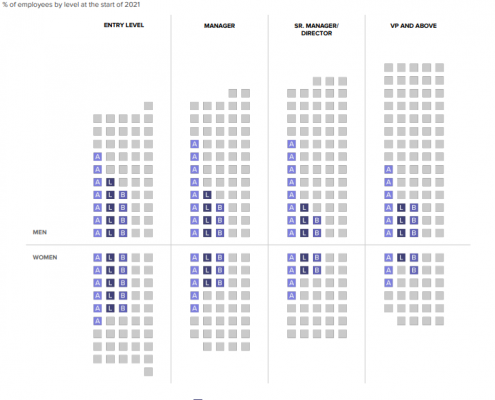
Women’s representation has increased across the pipeline since 2016. However, women—especially women of color—remain significantly underrepresented in leadership.

Women of color lose ground at every step in the pipeline
Representation of women of color falls off relative to white employees and men of color at every level of the corporate pipeline—leaving women of color severely underrepresented at the top.
“I’ve talked to white men who started off in the warehouse and now they’re at the VP level. I’ve also talked to a lot of Black and brown employees that have been here for 15 years and are at the same level they started at or they’re a little bit higher. But they’re nowhere near their white peers.”
– BLACK WOMAN, SENIOR MANAGER, CAREGIVER TO AN ADULT
The “broken rung” is still holding women back
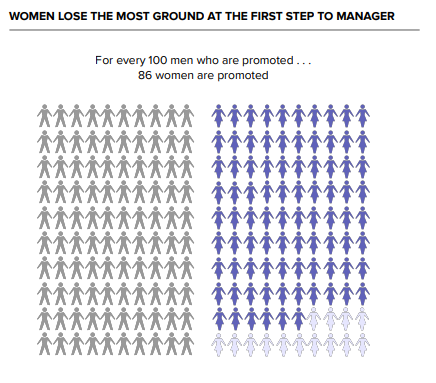
Women continue to face a “broken rung” at the first step up to manager: for every 100 men promoted to manager, only 86 women are promoted. As a result, men significantly outnumber women at the manager level, which means there are far fewer women to promote to higher levels. The broken rung likely explains why representation of women at the senior manager, director, and VP levels has improved more slowly than the pipeline overall.
This year, for the first time, women of color were promoted to manager at about the same rate as women overall: 85 women of color were promoted for every 100 men. This is important progress, and it will be critical that companies build on it to make promotion rates truly equitable.
Women are more burned out—and more so than men
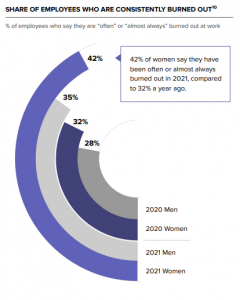 Women are even more burned out than they were a year ago, and the gap in burnout between women and men has almost doubled. In the past year, 1 in 3 women has considered leaving the workforce or downshifting their careers—a significant increase from 1 in 4 in the first few months of the pandemic.
“It’s the only time I’ve ever seriously considered a less demanding job. I interviewed for a job with another company. I just felt burned out so often. I probably cried more days than not. I felt caught in the middle of everyone’s emotional responses. I had to be the voice for a lot of different people, some of it was my job and some of it wasn’t. It was the hardest working year of my life.”
– WHITE WOMAN, SVP
Women are rising to the moment as stronger leaders, but their work is going unrecognized
The events of 2020 put extraordinary pressure on companies and employees. COVID-19 shook the economy and turned people’s lives upside down at work and at home. A heightened focus on racism and racial violence triggered a reckoning on diversity, equity, and inclusion. Companies’ priorities reflect these changes: an overwhelming majority say managers’ efforts to promote employee well-being are critically important and that DEI is one of their key areas of focus.
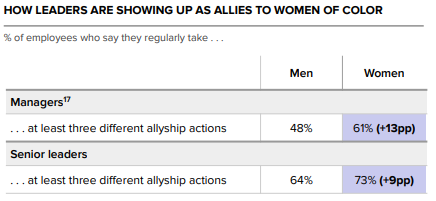
Women leaders are meeting the moment and taking on the extra work that comes with this. Compared to men at the same level, women managers are taking more action to support their teams, from helping employees manage their workloads to checking in regularly on their overall well-being. Senior-level women are twice as likely as senior-level men to spend substantial time on DEI work that falls outside their formal job responsibilities, such as recruiting employees from underrepresented groups and supporting employee resource groups. And women leaders are more likely to be allies to women of color. Compared to men in leadership, they are more likely to educate themselves about challenges women of color face at work, speak out against discrimination, and mentor or sponsor women of color.
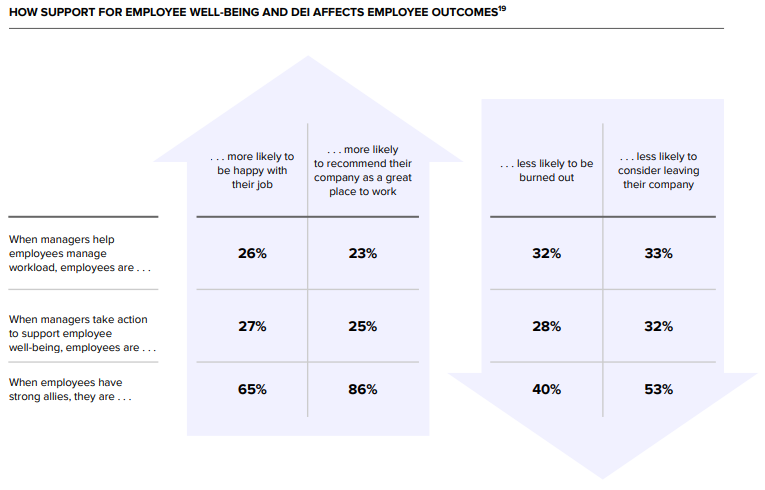
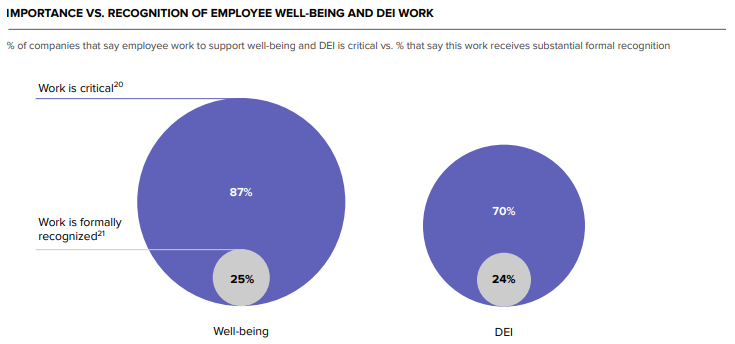
When managers support employee well-being and companies prioritize DEI, employees are happier, less burned out, and less likely to consider leaving their jobs. In spite of all this, relatively few companies formally recognize employees who go above and beyond in these areas—and this needs to change. Overlooking critical work around employee well-being and DEI has serious implications: It hurts women, who are investing disproportionate time and energy in these priorities. And it hurts companies and all employees, because progress is rarely made on efforts that are undervalued.
If companies don’t recognize and reward leaders’ efforts to support employee well-being and advance diversity, equity and inclusion, this critical work is at risk of being relegated to “office housework”— work that contributes to the business but isn’t taken into account in performance reviews, doesn’t lead to advancement, and isn’t compensated.
Women managers are doing more to support their teams
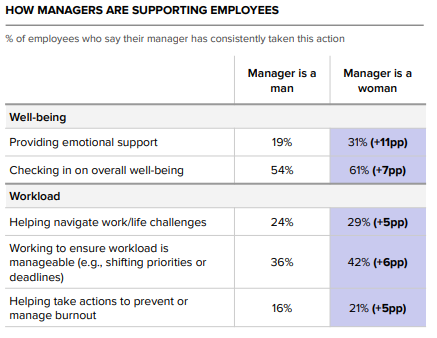 Compared to men in similar positions, women managers are consistently doing more to promote employee well-being—including checking on team members, helping them manage workloads, and providing support for those who are dealing with burnout or navigating work/life challenges. Women leaders are doing more than their share of mentorship and sponsorship. Men in senior leadership15 outnumber women 2 to 1—but employees are equally likely to say that women and men leaders have supported their career development. This means women are shouldering roughly double the load of mentorship and sponsorship.
“I feel so much responsibility for my team’s well-being. There is no line between the workday and the after-work day. We’re really underestimating the impact this is having on people personally and emotionally. I’m taking care of everybody. I will regularly have conversations with my team, ‘How are you feeling? What do you need? Can I remove barriers?'”
– WHITE WOMAN, SENIOR MANAGER
Women leaders are more active champions of DEI
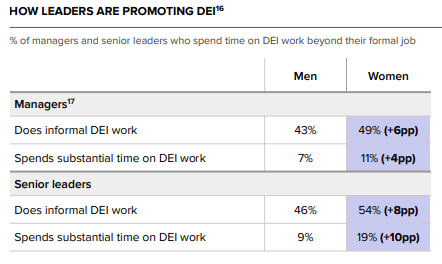
Compared to men at their level, women leaders are up to twice as likely to spend substantial time on DEI work that falls outside their formal job responsibilities—such as supporting ERGs, organizing events, and recruiting employees from underrepresented groups. They are also more likely than men to take allyship actions such as mentoring women of color, advocating for new opportunities for them, and actively confronting discrimination. 38% of senior-level women mentor or sponsor at least one woman of color, compared to only 26% of senior-level men.
Women leaders with traditionally marginalized identities are even more likely to contribute to DEI efforts. Among women at the manager level and above, Black women, LGBTQ+ women, and women with disabilities are up to twice as likely as women overall to spend a substantial amount of time on DEI work outside their formal job responsibilities.
“In my industry, there aren’t many women, not a lot of women of color, and definitely not a lot of women in leadership roles. So I’ve always been intentional to try to give back and do what I could to inspire and encourage and motivate those who need an advocate.”
– BLACK WOMAN, SENIOR MANAGER
The work women leaders are doing drives better outcomes for all employees
When managers support employee well-being, employees are happier, less burned out, and less likely to consider leaving. The same is true of employees who have strong allies and believe DEI is a high priority for their company.
This critical well-being and DEI work is going overlooked
Companies see the value of women leaders’ contributions. Almost 70 percent of companies say that the work employees do to promote DEI is very or extremely critical, and an even greater number say this is true of the work managers do to support employee well-being. But less than a quarter of companies are recognizing this work to a substantial extent in formal evaluations like performance reviews.
“We’ve been told that our DEI work is above and beyond our day jobs. It’s frustrating. We’re working on DEI after hours in the evenings, on weekends, and on vacation. And there’s no formal recognition of all the effort.”
– SOUTH ASIAN WOMAN, VP, CHILDREN OVER 10, IMMIGRANT
“I definitely think emotional labor is being taken for granted. We’re so focused on revenue as opposed to the skills required to manage teams remotely in a COVID world. I don’t think those skills and emotional labor are being formally recognized or that there’s any strong awareness around it.”
– EAST ASIAN WOMAN, VP, CHILDREN UNDER 10, IMMIGRANT
In addition to taking on more work, women leaders often face greater challenges
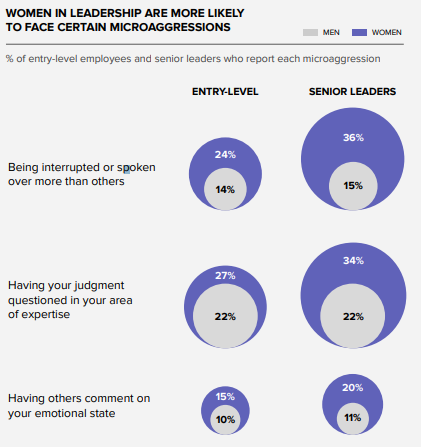
As women move into leadership roles, their day-to-day experiences often get more difficult. Compared to entry-level women, they are more than twice as likely to say they are “Onlys”, i.e., often the only or one of the only women in the room at work. They are also more likely to face microaggressions that challenge their competence—such as being interrupted, hearing comments on their emotional state, or having their judgment questioned. Men face these challenges more rarely and do not face them at greater rates as they gain seniority.
“The only other woman in leadership left as a result of burnout. She and I faced a lot of pushback when we tried to support employees during the pandemic. It disproportionately fell on us to offer that support. Some of the men in leadership wanted everyone to work in person more often, even at the height of the pandemic. It was very contentious, and I did not feel at all backed up by the men on the exec team.”
– WHITE WOMAN, SVP
Women leaders who manage teams are especially likely to be burned out and to have considered downshifting. More than 50% of women who are responsible for managing teams are often or almost always burned out, and almost 40% have considered leaving the workforce or downshifting their careers.
Women of color face more challenges and get less support
Even after a year of increased focus on DEI and racial equity in corporate America, women of color continue to face significant bias and discrimination at work. They are experiencing similar types of microaggressions, at similar relative frequencies, as they were two years ago. And although the number of white employees who identify as allies to women of color has increased over the past year, the number taking key allyship actions has not.
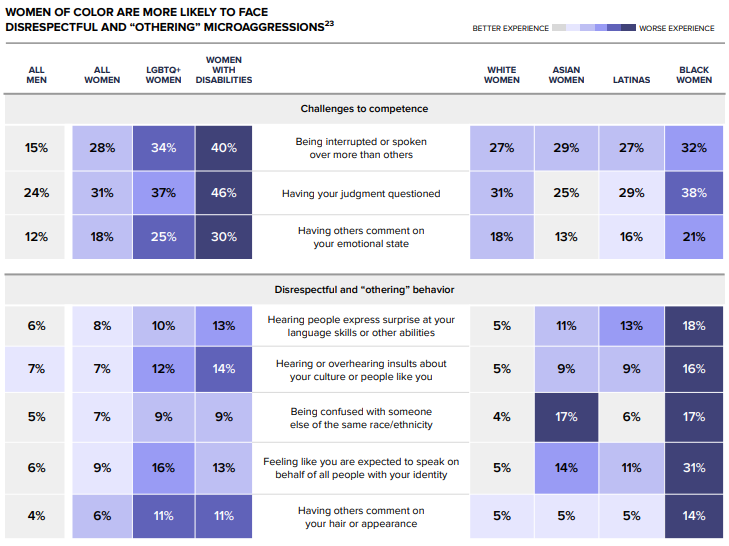
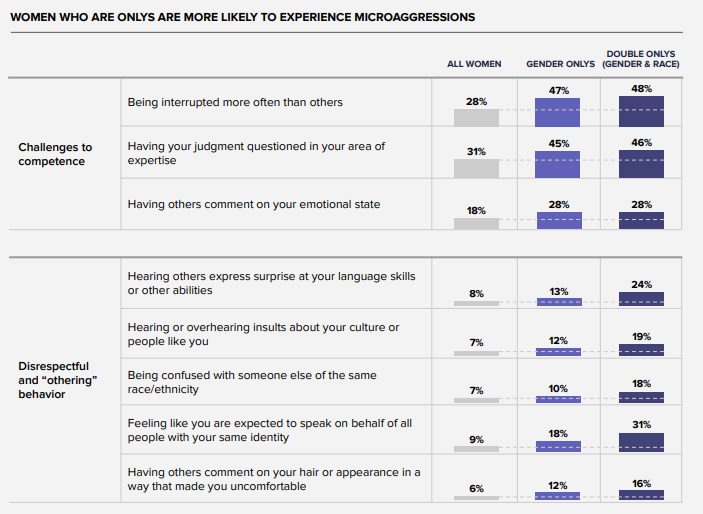
While all women are more likely than men to face microaggressions that undermine them professionally— such as being interrupted or having their judgment questioned—many women of color experience them at a higher rate. And women of color are much more likely than white women to face disrespectful and “othering” microaggressions that reinforce harmful stereotypes or cast them as outsiders. These experiences can take a heavy toll: women who regularly experience microaggressions are twice as likely as those who don’t to be burned out, more than twice as likely to report feeling negatively about their job, and almost three times as likely to say they’ve struggled to concentrate at work in the past few months due to stress.
Not only do women of color still face higher rates of microaggressions, they also still lack active allies. We continue to see a troubling gap: although more than three quarters of white employees consider themselves allies to women of color at work, less than half take basic allyship actions such as speaking out against bias or advocating for new opportunities for women of color. On top of this, there’s a notable disconnect between the allyship actions women of color find most meaningful and the actions white employees prioritize.
Given the day-to-day challenges women of color face, it’s not surprising that they are less optimistic than white women about their company’s commitment to DEI. Women of color are much less likely than white women to say their company prioritizes gender and race in DEI efforts—and less than half feel their company has substantially followed through on commitments to racial equity.
Women of color face a wider range of microaggressions
All women are more likely than men to face microaggressions at work. But for women of color and women with other traditionally marginalized identities, these experiences are more frequent and reflect a wider range of biases. For example, compared to white women, Black women are more than three times as likely and Latinas and Asian women are twice as likely to hear people express surprise at their language skills or other abilities—and we see a similar pattern for other common microaggressions.
LGBTQ+ women and women with disabilities are also significantly more likely than women overall to experience microaggressions. Women with disabilities, in particular, are much more likely than women overall to have their competence challenged or undermined at work.
The “allyship gap” persists
Allyship from more privileged colleagues can make a big difference in women of color’s experiences: when women of color feel like they have strong allies at work, they are happier in their jobs, less likely to be burned out, and less likely to consider leaving their companies. But although more than three quarters of white employees consider themselves allies to women of color at work, far fewer are consistently taking key allyship actions.
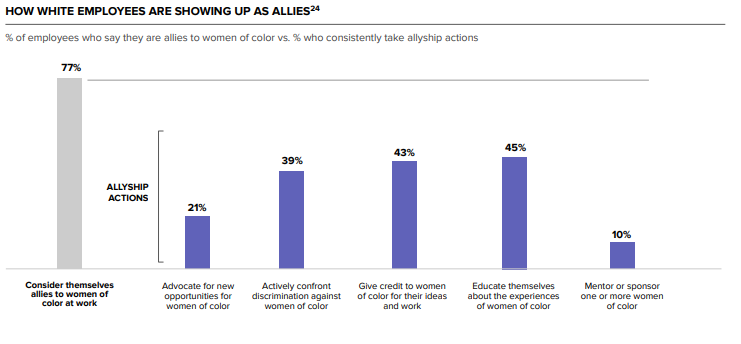
It’s critical that white allies actively confront bias and discrimination against women of color. When women of color take a stand, they too often experience retaliation—32% of Black women who’ve spoken out against bias and discrimination at work report experiencing retaliation, compared to just 6% of white men.
White employees don’t fully understand what allyship is
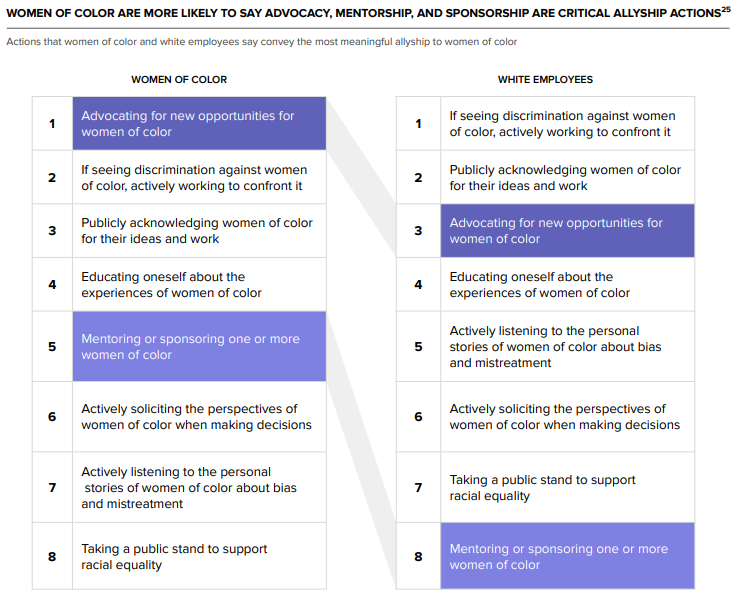
There’s a notable disconnect between the allyship actions women of color say are most meaningful and the actions white employees prioritize. Although white employees recognize that speaking out against discrimination is critical, they are less likely to recognize the importance of more proactive, sustained steps such as advocating for new opportunities for women of color and stepping up as mentors and sponsors.
Women who are “Onlys” and “double Onlys” have a much worse experience
Women who are “Onlys”—often one of the only people of their race or gender in the room at work—have especially difficult day-to-day experiences. Onlys stand out, and because of that, they tend to be more heavily scrutinized. Their successes and failures are often put under a microscope, and they are more likely to encounter comments and behavior that leave them feeling othered, excluded, and reduced to negative stereotypes.
Being an Only for one dimension of identity is already difficult. But women of color sometimes have to contend with being Onlys on two dimensions—both as the only woman in the room and as the only person of their race. “Double Onlys” face even more bias, discrimination, and pressure to perform, and they are even more likely to be experiencing burnout.
“Because I’m the only woman of color on my team, there’s a visible difference between me and the other people on the screen. And that can be intimidating. It makes me want to be cautious and more reserved about what I say or do. I feel like in those spaces, I’m representing either women or my race or ethnicity.”
– EAST ASIAN WOMAN, ENTRY-LEVEL
Being an Only can amplify the challenges of being a working mother
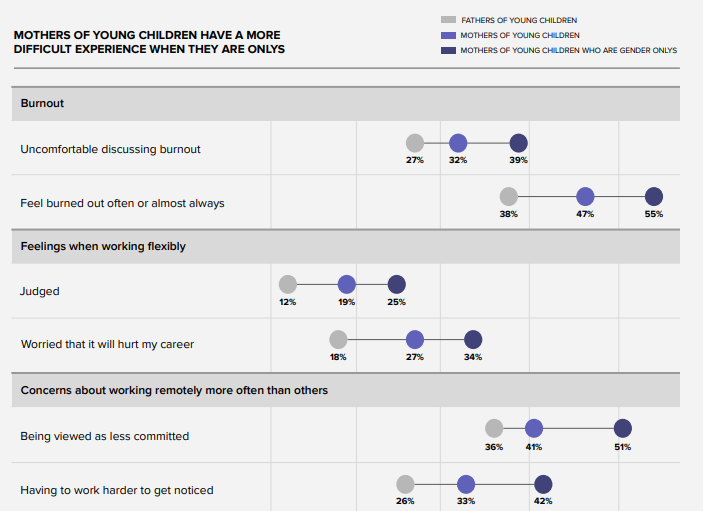
Being an Only or double Only can dramatically compound other challenges women are facing at work. Mothers of young children27 are one example of this; mothers already face more bias and barriers than fathers and women overall, and when they are often the only woman in the room, their experience is even more difficult.
Compared to mothers of young children who regularly work with other women, those who are Onlys are significantly more likely to be burned out and to have considered leaving their companies. They are more likely to feel judged when they take advantage of options that make it easier to balance work and life, such as working from home or working nonstandard hours. And they are less likely to feel comfortable sharing their personal challenges with colleagues, which may make it harder to get support.
The road to progress
As companies continue to manage the challenges of the pandemic and look to build a more equal workplace for the future, they need to focus on two key priorities: 1) advancing all aspects of diversity and inclusion, and 2) addressing the increasing burnout that all employees—but particularly women—are experiencing.
How companies can advance diversity and inclusion
Although we have seen important gains since 2016, women are still significantly underrepresented at all levels of management. On top of this, women continue to have a worse day-to-day experience at work. Women are more likely than men to have their competence questioned and their authority undermined, and women of color and other women with traditionally marginalized identities are especially likely to face disrespectful and “othering” behavior.
To drive change, companies need to invest deeply in all aspects of diversity, equity, and inclusion. This starts with taking bold steps to ensure that women of diverse identities are well represented, but diversity of numbers isn’t enough on its own. Companies also need to create a culture that fully leverages the benefits of diversity—one in which women, and all employees, feel comfortable bringing their unique ideas, perspectives, and experiences to the table. When women are respected and their contributions are valued, they are more likely to be happy in their jobs and to feel connected to their coworkers.
Where companies should focus to improve diversity
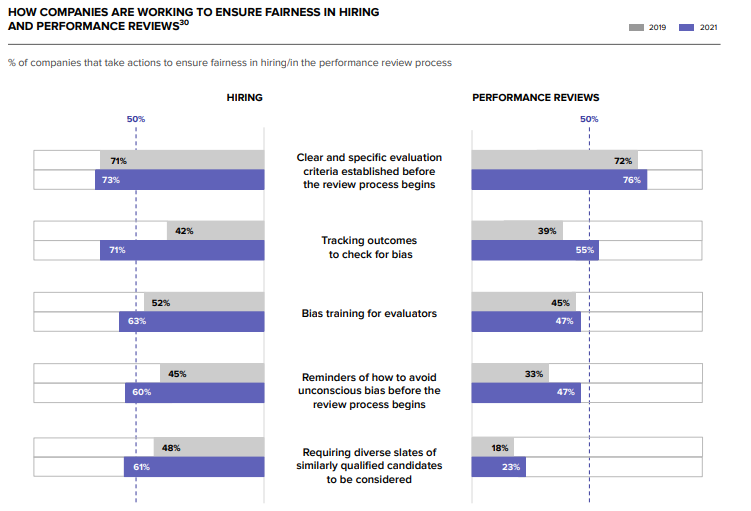
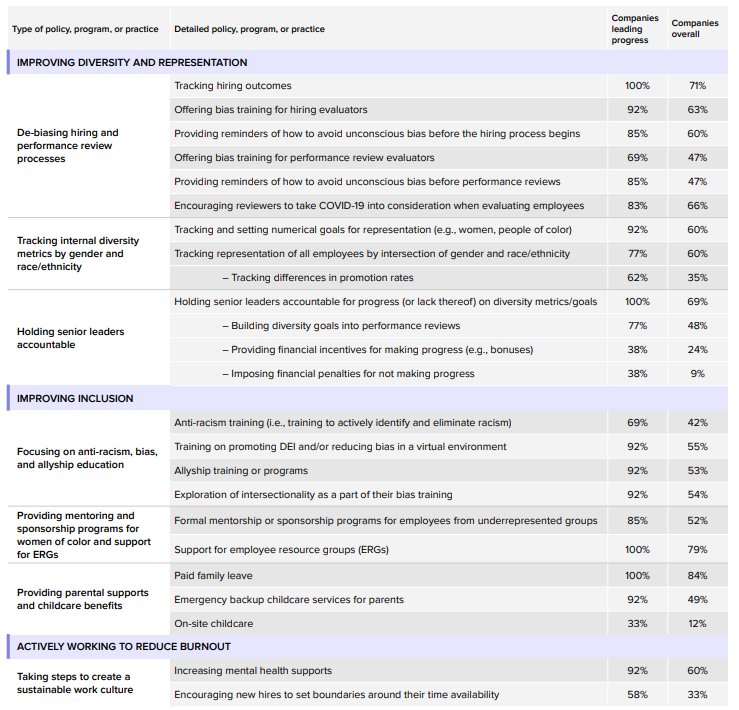
Over the last few years, more companies have implemented practices to ensure fairness in hiring and performance reviews, from requiring diverse slates for open roles to providing bias training for evaluators. These changes have produced positive results: companies that have made the greatest strides in women’s representation are more likely to have these practices in place.
However, gains since 2019 have been much greater in the C-suite than at lower levels, and they have benefited white women more than women of color. To drive sustainable progress for all women, companies need to take action to address two systemic weak points in the corporate pipeline: the “broken rung” in promotions at the first step up to manager, which leaves women dramatically underrepresented in mid-level management, and the sharp drops in representation of women of color at every level of advancement. These gaps largely explain why we see so few women—and almost no women of color—in senior leadership.
Although there are no quick fixes to these challenges, there are steps companies can take. First, they should ensure they are applying the same best practices, with the same level of rigor, across both hiring and performance reviews. Companies are currently doing more to reduce bias in hiring—for example, almost two thirds of companies offer bias training focused on hiring, compared to less than half of companies that offer this for evaluators involved in performance reviews. But performance reviews largely determine promotion outcomes, which means making them more equitable is critical to fixing the broken rung and advancing more women across the pipeline.
Top-performing companies are more likely to provide bias training and reminders of how to avoid bias before starting a hiring process or performance review cycle
Second, companies need to more fully track representation, as well as hiring and promotion outcomes. Although most companies track representation for women overall, far fewer do this for women of color, which means many companies are missing the critical visibility they need to make progress. Companies would also benefit by tracking hiring and promotions to determine whether women, and especially women of color, are being hired and promoted at similar rates to other employees. If they see gaps, they may need to fine-tune their hiring and promotion processes—and, more broadly, ensure that all women are getting the mentorship, sponsorship, and professional development needed to advance.
Top-performing companies are more likely to track hiring outcomes, such as the percentage of interviewees and hires who are from underrepresented groups.
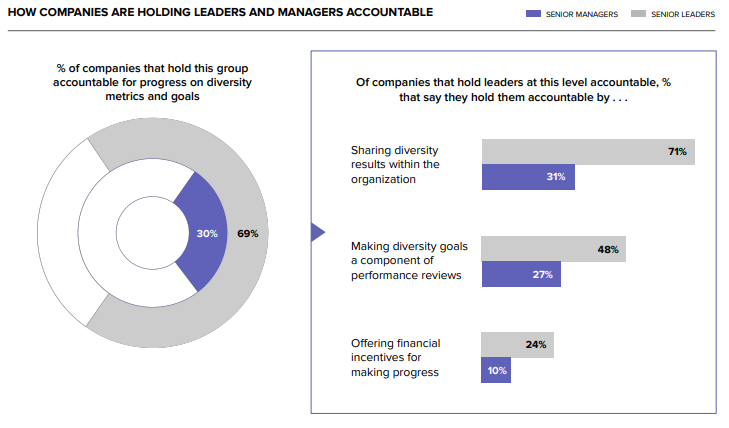
To accelerate progress for all women, on all fronts, companies need to double down on accountability. Despite saying that gender and racial diversity are among their most important business priorities, only about two thirds of companies hold senior leaders accountable for progress on diversity goals, and less than a third hold managers—who play a critical role in hiring and promotion decisions—accountable. Moreover, among companies that hold senior leaders accountable, less than half factor progress on diversity metrics into performance reviews and far fewer provide financial incentives for meeting goals. Companies need to treat diversity as they would any business priority, and that includes tying progress toward goals to advancement and compensation.
“At my company, inclusion and diversity is part of our publicly broadcast objectives and goals. Managers each take a piece of that responsibility and have skin in the game.”
– BLACK WOMAN, SENIOR MANAGER, CHILDREN UNDER 10
Top-performing companies are more likely to hold senior leaders accountable for diversity goals and to provide financial incentives for progress.
Companies put more emphasis on reducing bias in hiring than performance reviews
Since 2019, the number of companies implementing best practices to reduce bias in hiring and performance reviews has increased significantly. This is a step in the right direction—but there is a sizable gap between the share of companies that apply certain best practices to hiring, and those that apply the same practices to reviews.
Only 65% of companies track promotion rates by gender, and only 35% track promotions specifically for women of color (i.e., by the intersection of gender and race).
Companies can do more to hold leaders accountable for progress on diversity
More than two thirds of companies say senior leaders are held accountable for progress on diversity goals—but less than half as many hold managers accountable. In addition, among companies that hold senior leaders accountable, less than half say diversity goals are a component of their performance reviews, and less than a quarter offer financial incentives for progress.
“What gets measured gets done. Putting a target in place allows you to analyze the process end to end and truly assess the impact using real data and not ‘gut feel.’ We’ve really deepened our understanding of the systemic barriers in place and have been able to address them more effectively by tracking and setting numerical goals and targets.”
– SENIOR HR LEADER
How companies can make their workplaces more inclusive
Companies have strengthened their commitments to DEI and racial equity over the past year, but creating a more inclusive culture for women of all identities will take deep work and sustained investment. HR leaders say two things are critical to driving progress: senior-level sponsorship and high employee engagement.
Senior leaders need to fully and publicly support DEI efforts. When leaders actively participate in programs and events to advance DEI, they signal that this work is important. Senior leaders also have a critical role to play in ensuring that DEI initiatives are appropriately resourced. This is just another reason why it’s important that all company leaders, starting with the CEO, are held accountable for progress on diversity metrics.
But women’s day-to-day experiences are primarily shaped by their interactions with their direct managers and colleagues, which means companies need to equip employees at all levels to be part of the solution. This starts with raising awareness. Employees need to understand the barriers faced by women, particularly women with traditionally marginalized identities, and the benefits of a more inclusive culture. Companies can promote awareness by sharing data on the experiences of women in their organization, bringing in thought-provoking speakers, and encouraging employees to openly share their experiences and ideas for advancing DEI.
It’s important that DEI training covers the right material, with the right level of specificity. For example, only about half of companies say that their bias training addresses intersectionality—which means many employees are missing a crucial perspective on the experiences of colleagues with two or more traditionally marginalized identities, including women of color, LGBTQ+ women, and women with disabilities.
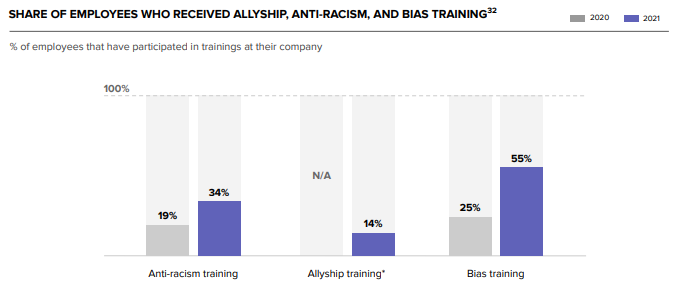
For employees to move from awareness to action, training is an important step. The number of employees receiving training on bias, anti-racism, and allyship is on the rise—but only 34 percent of employees have received anti-racism training in the past year, and just 14 percent have received allyship training. This suggests companies may need to take bolder steps to encourage participation, such as offering incentives or making training mandatory. They should also invest in ongoing employee education; it takes consistent reinforcement to reshape deep-rooted biases and change behavior, so a one-and-done approach to training is not enough. And companies need to be sure they are incorporating new ideas and tools from training into everyday processes, too. One example of this is sending out reminders of how bias can influence evaluations before hiring and promotion processes; research shows that this simple practice can improve outcomes for women and other people from underrepresented groups.
Finally, companies should clearly communicate what’s expected of employees and what it means to have an inclusive culture. Building this thinking into company values is a good place to start, but organizations would benefit from articulating the specific behaviors and actions that promote inclusion. In addition to signaling the importance of this work, clear guidelines will help set managers and all employees up for success.
Top-performing companies are more likely to offer allyship and anti-racism training for employees.
Companies can take steps to make the “Only” experience less common. Women who are “Onlys”—often the only person in the room of their gender, race or ethnicity, or both—have a significantly worse experience at work. To fully address this issue, companies need to improve the representation of women so there are fewer Onlys. Companies should also provide networking opportunities so women can connect across teams, and whenever possible managers should staff women on teams in groups of two or three.
Employees are receiving more training— but there’s still room to improve
The share of employees participating in anti-racism, unconscious bias, and DEI training has increased significantly in the past year. But only 34 percent of employees have participated in anti-racism training, and, notably, only 14 percent have received allyship training—which may explain the gap we see between employees identifying as allies and taking the actions that are most meaningful to women of color.
“This work takes time. There is no one right way to solve diversity and inclusion issues. Leadership must be early adopters, and DEI must be ingrained in a company’s culture and values. Additionally, DEI learning should be a journey—ongoing and continuous. It is important to make sure all employees get comfortable with being uncomfortable.
– SENIOR HR LEADER
How companies can begin to address burnout
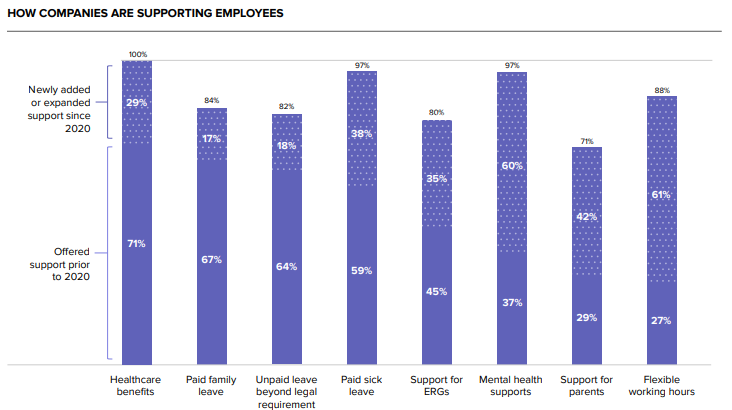
Companies have demonstrated a strong commitment to employee well-being over the past year. They have taken a wide range of steps to help employees weather the pandemic, including increasing mental health benefits, adding support for parents and caregivers, and offering more paid leave. These steps have led to better outcomes for all employees, and they have likely played a key role in helping women to stay in their jobs.
But burnout is still on the rise, especially among women. There is no easy fix, so continued investment will be critical. In addition to maintaining the successful policies and programs they’ve put in place, companies should look for opportunities to expand on them and try new approaches. It’s also important that companies establish new norms and systems to improve employees’ everyday work experiences—even with all the right policies and programs, employees will continue to struggle if the cadence and expectations of their work feel untenable.
Across all of their efforts to combat burnout, companies would benefit from embracing experimentation. There is no playbook for this unprecedented moment, but companies can make strides by listening closely to employees, exploring creative solutions, and trying something different if a new norm or program falls flat.
As companies embrace flexibility, they also need to set clear boundaries
Over the last 18 months, companies have embraced flexibility. More than three quarters of senior HR leaders say allowing employees to work flexible hours is one of the most effective things they’ve done to improve employee well-being, and there are clear signs it’s working. Employees with more flexibility to take time off and step away from work are much less likely to be burned out, and very few employees are concerned that requesting flexible work arrangements has impacted their opportunity to advance.
Employees have always cared deeply about flexibility. In 2019, the need for more work/life flexibility was the number-one issue employees had raised with their employers.
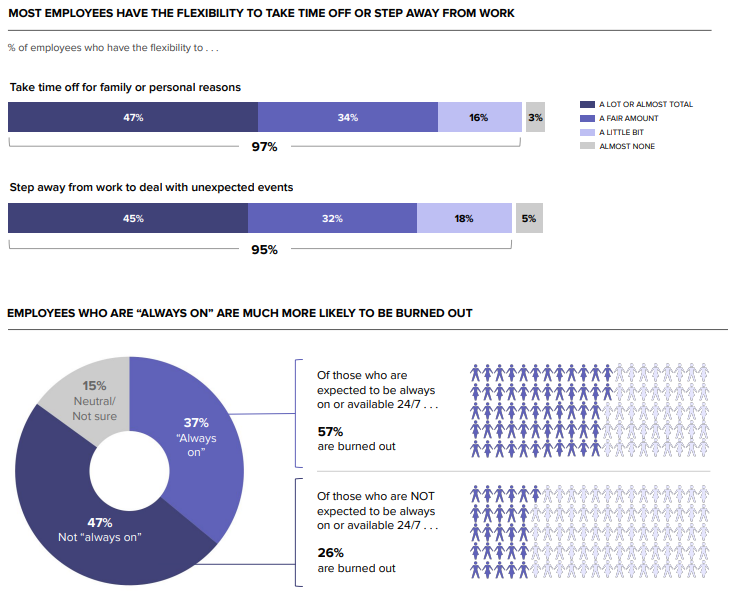
However, many companies are missing a crucial piece: without clear boundaries, flexible work can quickly turn into “always on” work. More than a third of employees feel like they need to be available for work 24/7, and almost half believe they need to work long hours to get ahead. Employees who feel this way are much more likely to be burned out and to consider leaving their companies.
The fact that so many employees feel “always on” signals that companies need to more explicitly define expectations. Right now, many companies are leaving it to employees to establish their own boundaries when they work remotely or work flexible hours—and while employees should be empowered to carve out personal time, companies have a responsibility to put formal boundaries in place across the organization. Only 1 in 5 employees says their company has told them they don’t need to respond to non-urgent requests outside of traditional work hours, and only 1 in 3 has received guidance around blocking off personal time on their calendars. Establishing or reinforcing work norms like these would go a long way toward reducing the feeling of being “always on.”
As companies navigate the transition to increased remote and hybrid work—with more employees working different schedules across different time zones—the risk of feeling “always on” will likely increase. Putting clear boundaries in place now can help companies ease this transition.
“Someone saying, ‘Hey, go take a couple days off to deal with this’ would go a long way. The company I work for is really strict about time off, which I think has led a lot of people in the organization to become really burned out. I know it’s caused me to get overly stressed and work more than I should to save up time to take off later, which just means you never recover from burnout.”
– WHITE TRANS WOMAN, ENTRY-LEVEL
Managers have an important role to play
Managers are on the front lines of employees’ day-to-day experiences, which means their actions have a significant impact on employee burnout and well-being. To improve outcomes, managers should focus their attention in three key areas: modeling work/life boundaries, ensuring that performance is evaluated based on results, and supporting employee well-being.
Employees often look to their manager to understand unspoken company norms and expectations. This means managers need to respect company-wide boundaries around flexible work—if employees aren’t expected to respond to emails during certain hours, managers need to abide by that norm. Managers can further reinforce the importance of these norms by celebrating employees who push back when boundaries are crossed and by encouraging candid conversations and problem-solving across the team if boundaries start to erode.
To underscore that employees are not expected to be “always on,” companies and managers need to work together to make sure all employees are evaluated based on results rather than when or where they work. A results-oriented lens is critical in formal performance reviews, and managers should be mindful of the day-to-day feedback they deliver to ensure they aren’t inadvertently signaling that long hours and face time are unspoken measures of performance.
It’s also important that managers actively monitor employees for signs of burnout and adjust workloads as needed. Although some managers are stepping up on this front—especially women—a majority of employees report their manager doesn’t check in on their well-being or help them shift priorities and deadlines on a regular basis. This suggests that managers need to touch base with their teams more consistently, and that these check-ins should be more explicit. Prompting employees to rate their level of stress and exhaustion on a one-to-ten scale, as opposed to generally asking them how they’re doing, creates more space for open, honest discussion.
Finally, companies need to impress upon managers that the work they do to support employee well-being is critical to the health and success of the business. For this work to feel like a real priority, it needs to be tied to concrete outcomes for managers, including performance ratings and compensation.
“My manager allowed me to work from home with flexible hours so that I could take care of my ailing parent. It’s always been, ‘We know you’ll get your work done, and we’re not worried about that. Take care of your family first, because if you and your family aren’t safe and healthy, then our company won’t reap the benefits of having you as an employee.”
– WHITE WOMAN, MANAGER, CAREGIVER TO AN ADULT
Companies are taking a wide range of steps to support employees
Many companies have significantly increased support for employees in the past year—from expanding mental health supports, to adding support for parents, to increasing flexible work and paid leave options.
Top-performing companies are more likely to provide childcare support to employees, including on-site childcare and emergency backup childcare services.
“Don’t assume that you know what is going to make a difference. Employees appreciate it when you ask for their input.”
– SENIOR HR LEADER
“We conducted many listening sessions with our ERGs to understand the challenges they faced during the pandemic and what the firm, leaders, and managers can do to support everyone. We found those sessions incredibly valuable—they surfaced a number of ideas, including strongly encouraging everyone to take time off and not scheduling meetings on Friday afternoons.”
– SENIOR HR LEADER
Employees have considerable flexibility, but “always on” culture is still driving burnout
Almost all employees say they have at least some flexibility to take time off and step away from work. However, more than a third feel like they are expected to be “always on,” and employees who feel this way are much more likely to say they are often or almost always burned out.
How top-performing companies are driving progress
Companies that are making consistent gains in women’s representation across the pipeline are more likely to have certain best practices in place. The following data are based on an analysis of top performers—companies that have higher representation of women and women of color than their industry peers, have made progress at most levels of the pipeline over the past four years, and have achieved greater equity in promotions at the broken rung.
This critical moment calls for critical commitment
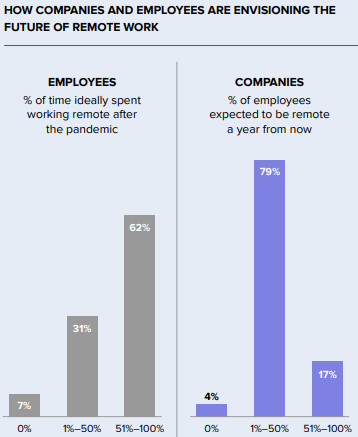
The immediate challenge for companies is to help employees get through the pandemic—and the work to get this right is far from over. But companies also need to start to plan for the future. The disruption of the last year and a half is driving a fundamental change in the way we work. Companies are embracing flexibility and remote work at levels that would have seemed impossible just a few years ago—and employees welcome the shift. It will take time for the full impact of the pandemic to come into focus, but one thing is clear: hybrid work is here to stay.
What’s unclear is whether companies can capitalize on this seismic shift—and the growing cultural focus on employee well-being and racial equity—to create a better workplace. It will require pushing beyond critically important but smaller wins in the representation of women, and doing the deep cultural work necessary to create a workplace where all women, and all employees, feel like they belong.
This will demand a level of investment and creativity that may not have seemed possible before the pandemic, but companies have shown what they can do when change is critical. Now they need to treat women’s equality and diversity, equity and inclusion with the same sense of urgency—and they need to reward the leaders taking us into the future.