Newsletter Subscribe
Enter your email address below and subscribe to our newsletter



As businesses navigate the competitive 2026 talent landscape, employer-sponsored child care has emerged as a critical driver of recruitment, retention, and productivity. Companies that provide robust child care support are not just offering a perk—they are making a strategic investment that yields returns as high as 425% and can significantly reduce employee turnover.
This comprehensive guide covers everything employers need to know about employer-sponsored child care programs, the transformative new tax credits available for 2026, implementation strategies, and real-world success stories.
Employer-sponsored child care refers to any benefit offered by a company to help employees manage the costs and logistics of child care. These programs can take many forms, from direct financial assistance and on-site facilities to partnerships with third-party providers.
The primary goal is to reduce the burden on working parents, enabling them to remain productive and engaged in the workforce. With only 12% of U.S. workers currently having access to employer child care benefits (Bureau of Labor Statistics, 2023), companies that offer these programs gain a significant competitive advantage.
In today’s economy, failing to support employees with child care needs comes at a steep price:
Key Finding: According to a landmark 2024 study by Boston Consulting Group (BCG) and Moms First, companies that invest in child care benefits see a return on investment (ROI) ranging from 90% to 425%. The study found that retaining as few as 1% of eligible employees can often cover the entire cost of the benefit.
Employers have several options when structuring child care benefits. The best choice depends on company size, employee needs, and budget.
| Benefit Type | How It Works | Best For | Key Considerations |
|---|---|---|---|
| Child Care Stipends | Employers provide a fixed, recurring cash allowance for employees to use on child care of their choice | Flexibility and remote workforces | Simple to administer, highly flexible, empowers employee choice |
| On-Site/Near-Site Centers | A child care facility located at or near the workplace, often run by the employer or a partner | Large employers with concentrated workforces | High initial investment, but maximum convenience |
| Backup Care | Provides emergency or last-minute child care when regular arrangements fall through | All businesses | Prevents unexpected absenteeism |
| Dependent Care FSA (DCFSA) | A pre-tax benefit account used to pay for qualified dependent care services | Companies seeking simple, tax-advantaged options | Employee-funded; $5,000 annual limit per household |
| Resource & Referral Services | Connects employees with vetted child care providers in their area | Companies with limited budgets | Low cost, but limited direct financial support |
A major legislative update—the One Big Beautiful Bill Act (OBBBA)—has significantly expanded the Employer-Provided Child Care Tax Credit (Section 45F) for the 2026 tax year. This makes offering child care benefits more financially viable than ever before.
| Feature | Previous Rule (Pre-2026) | NEW Rule (2026+) |
|---|---|---|
| Credit Percentage | 25% of qualified expenses | 40% (Standard) / 50% (Small Businesses) |
| Annual Cap | $150,000 | $500,000 (Standard) / $600,000 (Small Businesses) |
| Flexibility | Limited | Easier to work with third-party providers |
What qualifies for the credit?
How to claim: File IRS Form 8882 with your annual tax return.
Step 1: Assess Employee Needs
Survey your employees to understand their specific child care challenges, preferences, and what type of support would be most valuable.
Step 2: Evaluate Program Types
Use the comparison table above to determine which benefit model aligns with your company’s budget and employees’ needs.
Step 3: Partner with a Turnkey Provider
Implementing and managing child care benefits can be complex. Partnering with a specialized provider like TOOTRiS streamlines administration, ensures compliance, and gives employees access to a vast network of licensed child care options.
Step 4: Communicate the Benefit
Clearly and frequently communicate the new benefit to employees. Highlight the value and explain how to access it to ensure high utilization.
Step 5: Measure and Optimize
Track metrics like utilization rates, employee retention, and absenteeism to measure ROI and refine your program over time.
Mazda Toyota Manufacturing (MTM)
After partnering with TOOTRiS to provide child care benefits, MTM reported:
Etsy
The e-commerce company offers up to $4,000 per year in child care credits. A BCG survey found that 82% of working parents said the benefit was an important factor in their decision to work there.
Synchrony
The financial services firm provides up to 60 days of backup care reimbursements. Company CTO/COO Carol Juel states: “Our childcare benefits are making Synchrony a leading employer of choice while strengthening our workforce.”
Patagonia & J.P. Morgan
Both companies report ROI exceeding 115-125% from their child care programs, attributed to reduced turnover, increased loyalty, and enhanced productivity.
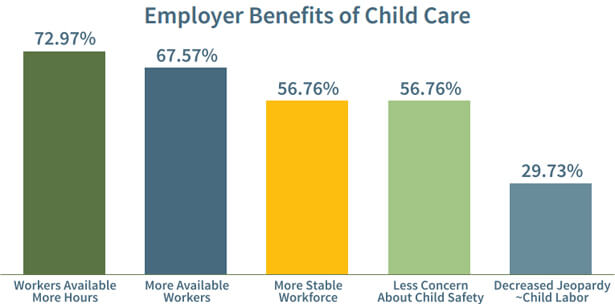
| Statistic | Source |
|---|---|
| 90-425% ROI from child care benefits | BCG/Moms First, 2024 |
| Only 12% of U.S. workers have access to employer child care benefits | Bureau of Labor Statistics, 2023 |
| 86% of employees more likely to stay with employer offering child care | BCG, 2024 |
| $23 billion annual cost to employers from child care challenges | HomeThrive, 2025 |
| 1 in 5 workers have left jobs due to inadequate child care | Wonderschool, 2025 |
| 40-50% tax credit now available under Section 45F | OBBBA, 2025 |
| $500,000-$600,000 maximum annual tax credit | Section 45F Expansion |
What types of expenses do employer-sponsored child care benefits cover?
Employer-sponsored child care can cover daycare, preschool, after-school programs, backup care services, summer camps, and in-home nanny services. Stipend programs offer the most flexibility, allowing employees to choose their preferred provider.
Are employer-provided child care benefits taxable?
Under IRS guidelines, up to $5,000 per household in dependent care benefits (like a DCFSA) can be tax-free. Direct stipends may be taxable to employees, but the expanded employer tax credits significantly offset these costs for businesses.
What is the difference between a DCFSA and a child care stipend?
A DCFSA is a pre-tax account funded by the employee with strict IRS limits. A stipend is a direct, cash-based benefit funded by the employer, offering greater flexibility and typically higher utilization rates.
Can businesses receive tax credits for offering child care benefits?
Yes. Under the expanded Section 45F, businesses can claim up to 40% of qualified expenses (50% for small businesses), with a maximum annual credit of $500,000 ($600,000 for small businesses). File IRS Form 8882 to claim.
Are employers legally required to offer child care benefits?
No federal mandate exists, although some states have specific regulations. These benefits are voluntary but increasingly considered essential for competitive talent acquisition.
Why partner with a third-party provider instead of building an in-house solution?
Third-party services like TOOTRiS eliminate administrative burden, reduce legal and compliance risks, and provide employees with a much broader network of care options than a single on-site center could offer. Approximately 32% of employers already prefer these specialized partnerships.
How does providing child care benefits impact employee productivity?
Employees with reliable child care are 69% less likely to seek new employment. Companies see marked improvements in retention, productivity, and workplace morale due to decreased stress and increased satisfaction.
What is the IRS Employer-Provided Child Care Credit?
The credit (Section 45F) allows employers to claim up to 40% of qualified child care expenditures and 10% for resource and referral expenses, up to a maximum of $500,000 per year (2026 rules).
TOOTRiS provides an innovative, turnkey platform that connects employees to tens of thousands of licensed child care providers in real-time. Our solution allows employers to:
TOOTRiS clients report substantial returns from decreased absenteeism and turnover, with case studies showing 11-20% reductions in attrition.
For more details, visit TOOTRiS.com/employers. For a detailed analysis of the return on investment for child care benefits, refer to our CFO’s Guide to Child Care Benefit ROI.
Employer-sponsored child care is no longer a “nice-to-have”—it’s a strategic imperative. With the expanded Section 45F tax credits making these benefits more affordable than ever, 2026 is the year for businesses to act.
Companies that invest in child care support gain clear competitive advantages in employee satisfaction, retention, productivity, and company culture. With ROI ranging from 90% to 425%, providing child care benefits is arguably the smartest investment businesses can make today.
Ready to take the next step? Contact TOOTRiS to explore how we can enhance your employee support strategy.