Newsletter Subscribe
Enter your email address below and subscribe to our newsletter



Moms cannot work without child care – period. And yet, child care too often is seen as a personal problem for families to solve.
A new report with original data developed by the MomsFirst and their knowledge partner McKinsey that shows amid the Great Resignation, expanded child care benefits can help companies attract, retain and advance women in the workforce.
Not only can you download the PDF for your own resources, but you can review the full report below!
How parent-focused employee value propositions help companies win the war for talent
This report seeks to understand the impact of the U.S. child care support ecosystem on companies and workers and how the private sector can address child care needs and help companies win the war for talent. McKinsey & Company served as a knowledge partner for this report, providing research, data, and analysis, including insights from a survey of 1000+ American parents with children ages 0-5. Survey details can be found in the Methodology and Disclaimers sections.
Disruptions to school and child care during the COVID-19 pandemic caused working mothers to leave or lose their jobs at a higher rate than fathers—and many have not returned. Single mothers of color have been particularly affected with the highest unemployment rates among different parent populations. Even before the COVID-19 pandemic, household labor was already imbalanced. In fact, women in the United States spent 37% more time on unpaid household and care work than men, with insufficient policy attention focused on meeting the needs of working mothers.
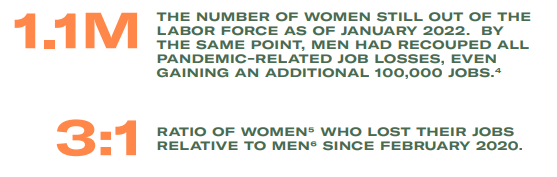
1.1 MILLION– The number of women still out of the labor force as of January 2022. By the same point, men had recouped all pandemic-related job losses, even ganining an additional 100,000 jobs.
3:1 – Ratio of women who lost their jobs relative to men since February 2020.
U.S. Child Care in Crisis
The U.S. child care system not only often fails working families—it is also contributing to long-term trends that could imperil American competitiveness. Other countries are increasingly investing in child care as a lever for economic competitiveness. For example, China provides tax exemptions for the cost of raising children under three and for day care providers, while Germany guarantees day care spots for all children over the age of one.

$840B – Amount in economic output that the U.S. is potentially losing out on with women’s labor force participation muted, according to Mckinsey Global Institute.
Providing child care benefits can improve recruitment and retention rates, which may increase worker productivity and reduce burn-out.
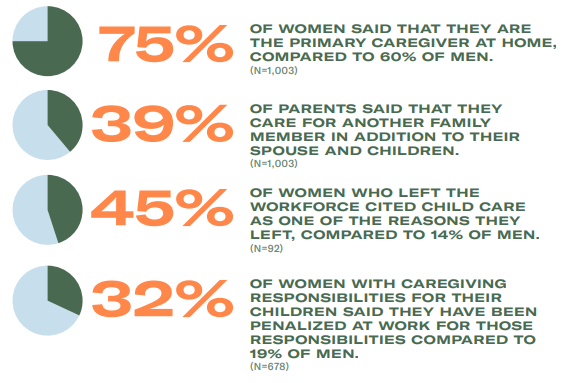
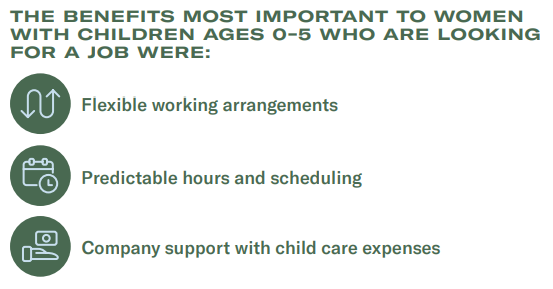
88% OF WOMEN WITH CHILDREN AGES 0-5 LOOKING FOR A JOB SAID THAT HAVING WORK FLEXIBILITY, PREDICTABLE HOURS, OR CHILD CARE SUPPORT WOULD MAKE THEM MORE LIKELY TO CHOOSE AN EMPLOYER
The emergence of COVID-19 in late 2019 and early 2020 threw the global economy into a tailspin and held up a mirror to our systems, culture, and values. The pandemic revealed hidden truths and invited Americans to question long-held assumptions about what types of labor—and whose labor—was seen as valuable, and why.
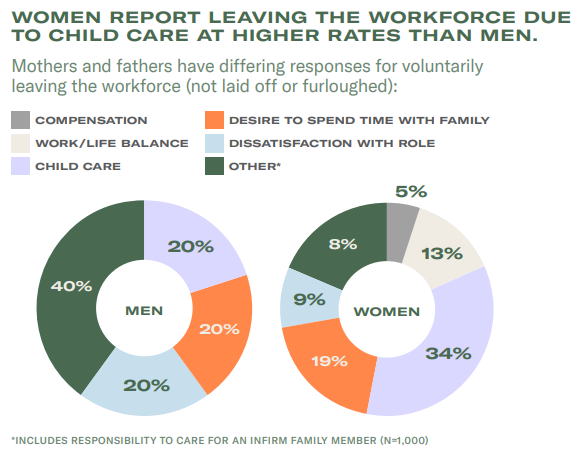
When what felt like overnight, schools, day cares, and child care programs closed, working mothers stepped in to fill the child care gap, leaving—or being forced to leave—their jobs at a higher rate than fathers. In fact, more than 1.4 million moms left the labor force in 2020 alone, adding to the dramatic drop in employment now referred to as “The Great Resignation.” Single mothers of color have been particularly affected with the highest unemployment rates among different parent populations. Even before the COVID-19 pandemic, women in the United States spent 37% more time on unpaid household and care work than men, with insufficient policy attention focused on meeting the needs of working mothers.
As of May 2022, many working mothers still have not returned to the workforce, confirming what a U.S. Census study warned in 2021: that the economic recession hitting working mothers would become prolonged and increasingly severe. Our survey of 1000+ parents with children ages 0-5 found that child care was one of the reasons most commonly cited as to why they had left the workforce. The detailed survey methodology is outlined in the Methodology section of this report.
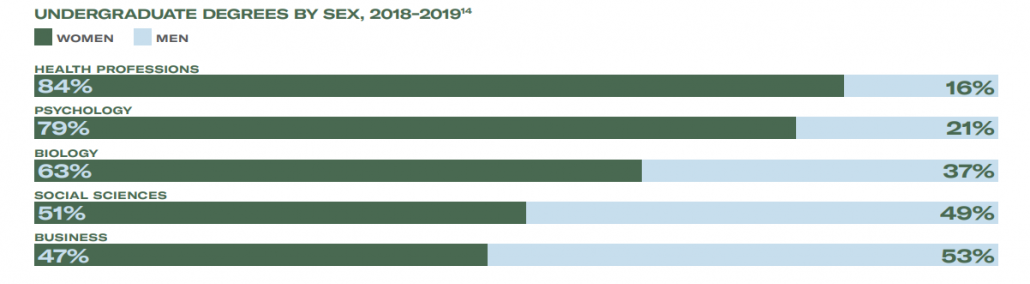
Even before the pandemic, women earned more than 50% of undergraduate degrees in key sectors, such as healthcare, which is critical to American economic output. However, women also faced disproportionate household and care responsibilities and insufficient child care infrastructure, creating barriers to both entering and advancing in the workforce.
During COVID-19, the U.S. child care sector underwent a systems failure brought about by decades of underinvestment. The COVID-19 pandemic focused the nation’s attention on the patchwork caregiving ecosystem made up of day care (center-based, home-based), nannies/ babysitters, family and friends, private pre-K, and afterschool care that parents are required to navigate.
PARENTS IDENTIFIED 5 MAIN CHALLENGES RELATED TO THE CHILD CARE ECOSYSTEM:
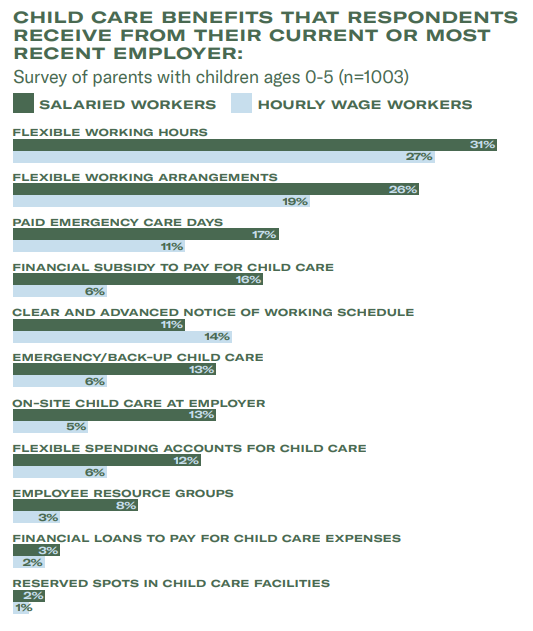
Access to suitable child care is key to helping women return to the workplace and stay there long-term. Unfortunately, the opposite is also true: when families cannot find suitable care, women’s employment is disproportionately impacted.15 Our study found that states with fewer child care deserts have higher maternal labor force participation. This is particularly true of parents with lower incomes: 67% of respondents with children ages 0-5 making less than $30,000 and 50% of those earning $31,000-$50,000 selected child care as a key reason they are not currently working. For many workers, their pay may not cover the cost of child care. And yet, working parents have only limited access to child care benefits in the workplace. Across the board, hourly workers have fewer child care benefits than salaried workers, and employees in rural areas have fewer benefits than those in urban areas.
1 in 11 parents reported having access to financial subsidies to pay for child care or on-site child care at their employer.
With women’s labor force participation muted, the U.S. is potentially losing out on up to $840 billion in economic output annually. That means 40% of the incremental GDP can be obtained from higher female labor force participation. Meanwhile, many countries are investing in child care as a lever for economic competitiveness, such as China, Japan, Canada, and Germany.
$840 Billion – Amount in economic output that the U.S. is potentially losing out on with women’s labor force participation muted.
Corporate America is in the midst of a talent crisis, with insufficient child care support for employees as one contributing cause. Nearly 4.3 million people quit their jobs in January 2022 alone, following a record year for resignations, in which almost 48 million people quit their jobs.
Employers that provide child care benefits can improve recruitment and retention of women, increase worker productivity, and in turn, boost overall American competitiveness.
AFFORDABILITY
Options fit within parents’ spending means and do not create outsized cost burdens
POTENTIAL EMPLOYER OFFERING
ACCESSIBILITY
Locations provide an adequate number of spots and sufficient child care workers to serve children’s needs
POTENTIAL EMPLOYER OFFERING
CONVENIENCE
Options align with parental lifestyle including location and operating hours
POTENTIAL EMPLOYER OFFERING
RELIABILITY
Coverage that is reliably open, including when primary child care is unavailable
POTENTIAL EMPLOYER OFFERING
QUALITY
High-quality child care that is equitably available to employees in different roles and companies
POTENTIAL EMPLOYER OFFERING
Companies can better meet their employees’ child care needs by diagnosing the problem, designing feasible solutions, and driving adoption. Organizations that are just beginning their journey to better support working parents with child care can follow this four-step approach—one that centers employee feedback, accounts for different life experiences, and creates practices that work best for all employees:
Second, evaluate how child care benefits could influence your bottom line from a holistic perspective. For example, some companies may recoup much or all of the expenses related to the cost of child care benefits through improved employee retention.
Third, review your capabilities and assets. This calls for critical and creative thinking. Pooling resources for child care benefits among small businesses could help distribute costs. Consider what underutilized corporate assets could be brought to bear. For example, vacant or under-used real estate could be a viable location for worker child care centers.
Bank of America
Bank of America provides child care subsidies to make child care more affordable for all employees. Employees can receive up to $275 per month, per eligible child, through the Child Care Plus program. The benefit is offered for employees making less than $100,000 per year. It can be used for both formal and informal child care (e.g., nanny, neighbor), is applicable to children under 13 years old, and is available for full and part-time employees, as well as salaried and hourly wage workers.
Patagonia
Patagonia’s on-site child care centers are available to both retail and corporate employees. The organization provides on-site child care at headquarters in Ventura, CA, and a distribution center in Reno, NV. The tuition is assessed on a sliding scale based on household income. Spaces are available to both hourly and salaried workers and to retail workers at locations near the child care centers. Patagonia recoups ~90% of the cost of the child care center through tax benefits, employee retention, and employee engagement.22
Synchrony
Synchrony credits its approach to supporting families through the pandemic for how well they weathered the storm as an institution. Synchrony assessed child care needs for both corporate and call center employees through surveys and listening sessions to empower employees to identify the most pressing needs and solutions. Synchrony offers a package of benefits including 60 days of back up child care, virtual afterschool/summer camp programs and tutoring, flexibility in hours and in working from home. Synchrony’s back-up care benefit made it easy for their employees to choose the best provider for their situation (e.g., family member, home-based care or child care center), ensuring employees could access backup care on short notice.
MomsFirst is a national movement to center mothers in our economic recovery and value their labor. Download the full report to learn how your business can support mothers and secure a more prosperous economic future for all.