Newsletter Subscribe
Enter your email address below and subscribe to our newsletter


Editor’s note: the following report was release by the New York City Economic Development Corporation as a PDF. For those unable to view large PDFs, we have transcribed the contents below. You can download the original PDF here.
Even before COVID-19, US employers lost $12.7 billion a year to employees’ childcare challenges. COVID-related daycare and school closings deepened those losses as over four million women left the US workforce in 2020. Overall, New York City Economic Development Corporation (NYCEDC) estimates the 2022 economic impact to New York City of parents leaving or downshifting careers due to increased caregiving responsibilities because of the pandemic to be a $23 billion decrease in economic output, a $5.9 billion drop in disposable income, and $2.2 billion less in tax revenues.
Employers across the US want to help working parents. Since the start of the pandemic, the US Chamber of Commerce has received hundreds of queries from businesses seeking strategies. Boston Consulting Group, Wells Fargo, and McKinsey & Company have all published reports urging companies to support employees’ childcare needs. Several noteworthy companies are pledging to do so by joining the new National Business Coalition for Childcare, launched by the Marshall Plan for Moms.
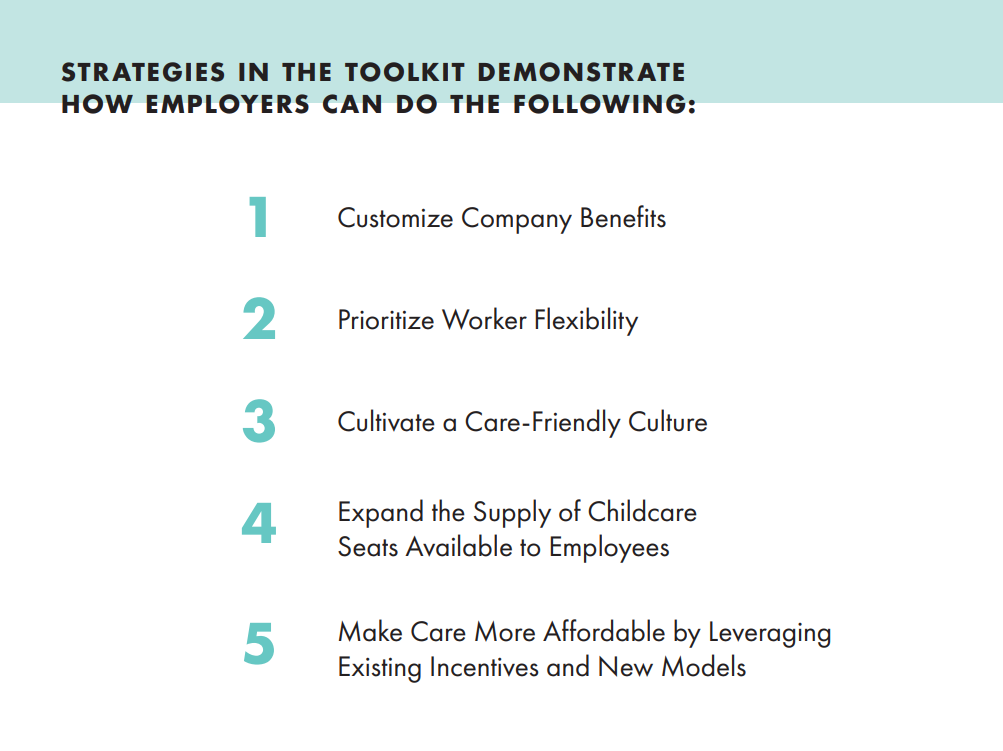
This toolkit outlines five key strategies that chief people officers and other senior leaders can use to support caregivers, plus practical tools to aid in implementation. Case studies spotlight companies that are introducing new family-friendly policies to improve talent attraction, retention, and productivity. Together, they offer a roadmap for employers who want to deliver a childcare strategy that is employee centered, data-driven, innovative, and customizable, and that offers a high return on investment (ROI). The guide is not meant to be a “one-size-fits-all” approach given the disparate needs of employers, but rather offers an overview of current options.
The toolkit was born out of a study by NYCEDC’s women.nyc Childcare Innovation Lab — a team dedicated to researching childcare as an economic issue, catalyzing public and private sector solutions, and supporting innovative approaches. The research explored how employers envision their role in supporting caregivers given vast disruptions in work and home life. Our research partner Seramount conducted a series of interviews and surveys with more than 30 human resources and benefits leaders across New York City between June and September 2021. Participants represent 11 industries and include businesses with non-standard work hours and both hourly and salaried employees.
Over the course of this research and numerous conversations with corporate leaders since 2020, three employer actions were identified to help increase the participation of caregivers in the economy:
This toolkit compiles best practices across these fronts.
This effort is part of Mayor Eric Adams’s new Blueprint for Childcare & Early Childhood Education in New York City, an ambitious plan to provide affordable, equitable, high-quality childcare and education across the city. Among the strategies it lays out are financial benefits for employers that help provide childcare for their workers, including tax credits for employers that provide free or subsidized childcare as well as property tax abatements for building owners retrofitting space to accommodate childcare centers. The Blueprint strategies total approximately $800 million in additional planned investments to support childcare service delivery in New York City. Combined with existing childcare spending this represents a total of approximately $2 billion over the next four years.
Employers have a vital role to play in galvanizing change in the lives of working families. We look forward to continuing to work with employers and other stakeholders across our city to support an equitable economic recovery.
The price employers pay due to inadequate childcare infrastructure is high and growing. Even before the pandemic, in 2019, US employers lost an estimated $12.7 billion due to the impacts of childcare challenges on key performance indicators; the pandemic has only intensified these losses.
A growing body of research indicates that family-friendly practices pay off for companies. Key business areas that are positively impacted include talent attraction, productivity, retention, and diversity. Measuring ROI has also been key to making the case for childcare investments and to enabling decisionmakers to home in on which benefits would best serve employees and the organization at large.
J.P. Morgan estimates a 115 percent ROI for its childcare program. When the financial services firm surveyed employees who used a back-up care program (105,000 childcare-related back-up days in 2015 alone), 80 percent responded that they would have taken unscheduled time off from work without the program and 77 percent said backup care allowed them to focus better at work. Childcare provider Vivvi estimates that the financial impact to an employer of investing in 10 childcare seats can be nearly $600,000 in annual savings due to improved recruitment, reduced absenteeism and increased retention and productivity. Using New York City childcare cost data from Upfront, an online resource for early education, it is estimated that even if New York City companies cover the entire cost of center-based care for their workers, they may expect a 300 percent ROI.
Recent research shows that 79% of mothers and 61% of fathers say expanding employer-provided childcare benefits is a top priority. Caregivers value childcare at the same level as salary, equity, paid time off, and healthcare when looking at a new role.
In one study, 71% of working caregivers said better childcare would make them more productive at work and 75% said it would make them more likely to stay with their employer.
When companies address unique reasons for burnout, their employees are 20 times more likely to intend to stay at their job.
Offering better childcare benefits can improve diversity, and companies in the top quartile of racial and ethnic diversity are 35% more likely to have financial returns above the national industry median.
Appendix A highlights practical tools that can aid organizations in measuring the ROI of supporting childcare.
Patagonia is considered a standard-bearer in benefits for caregivers. It offers company-paid healthcare and sick time; paid maternity and paternity leave; access to on-site childcare for employees at its Ventura, California headquarters and at its Reno, Nevada distribution center; and financial support for childcare to those who need it. The CEO justifies the investment in the childcare center given that about 91 percent of costs are recouped at various levels, including: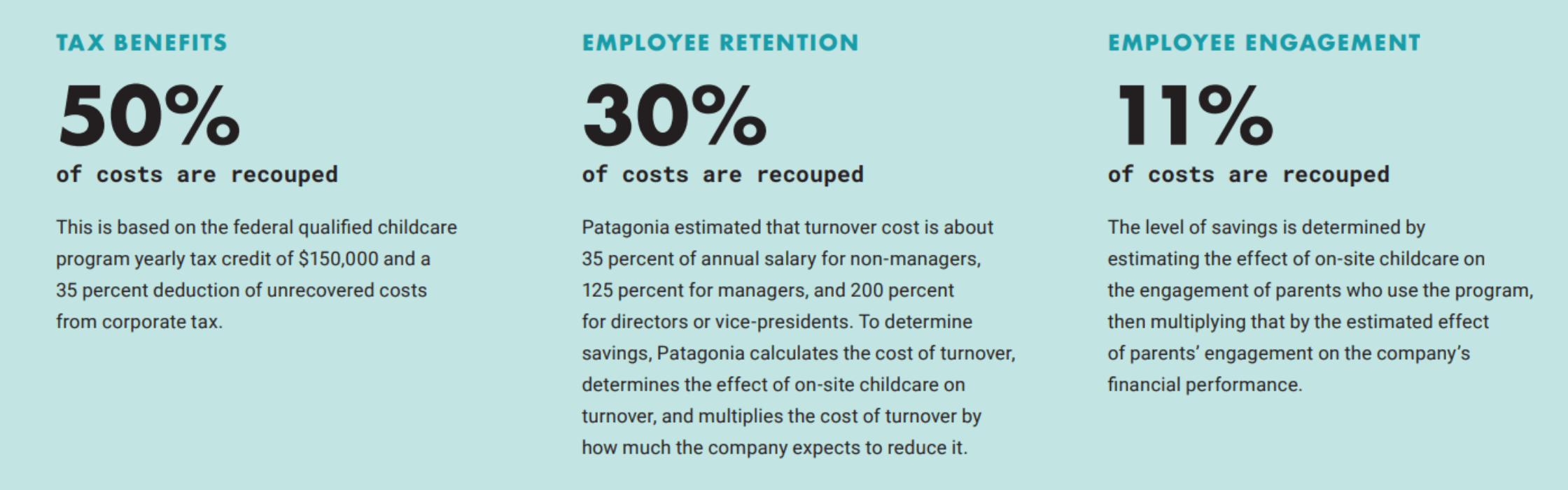
The pandemic laid bare how accessible, high-quality childcare is a linchpin of the economy. Today, employers are increasingly recognizing it as a critical part of business infrastructure and a bedrock of labor force participation, particularly for mothers. Since March 2020, many New York City employers have offered expanded flexibility and other family-friendly benefits.
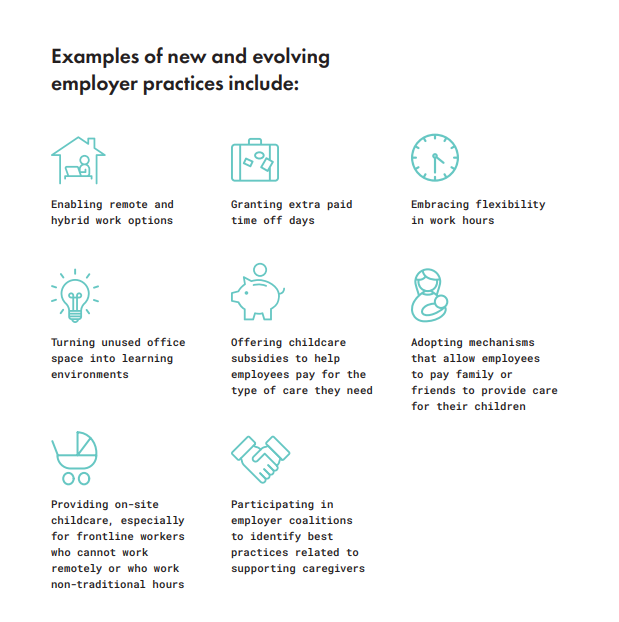
More employers are tailoring benefits to meet the evolving needs of a diverse workforce.
THE NEED
Historically, few companies tracked the caregiving status of employees or inquired about their care-related needs, yet 83 percent of women and 81 percent of men report childcare benefits would be an important factor in deciding to stay at their current employer.
ACTION STEP
In response to the pandemic and growing interest among employees, more companies are using employee data to customize childcare benefits that offer the best ROI for their company. Employers can gather data about employee needs as the foundation to launching or modifying benefits to drive better usage and business outcomes.
CASE STUDY: Carter’s, a children’s apparel retailer, introduced new benefits as a result of several listening sessions held throughout 2020 to understand working caregivers’ problems. The discussion prompted the retailer to offer a customized tools and resources platform, as well as enhance its package through Bright Horizons to offer tutoring, preferred enrollment, discounts at centers, and discounts for enrichment programs and camps.
One financial services company went from offering 20 days of subsidized childcare (at up to $60 a day) at a network-approved in-home or center-based care provider, to offering 30 days of subsidized care (at up to $100 a day), reimbursing anyone coming to their home, including a relative or friend. Another decided to swap its underutilized back-up childcare services for virtual tutoring for children or summer camp discounts.
ACTION STEP
Companies can shift from a limited list of benefits offerings to more flexible options that enable employees to use the benefits that are most valuable to them. Allowing for customization helps companies increase business metrics like talent attraction and retention by accommodating caregivers at different life stages.
CASE STUDY: Vivvi, a childcare provider, works with employers to allot employees “Care Cash.” Care credits are assigned a dollar amount that can be applied toward varying care needs and preferences such as in-home care, after-school tutoring, in-office care, or placement of children in day care campuses.
CASE STUDY: Fast Retailing USA, which operates apparel brands including Uniqlo, Theory, and Helmut Lang, offers monthly childcare stipends of up to $1,000 for many employees, including store managers. Funds can be spent as employees see fit rather than being tied to specific providers.
CASE STUDY: Dropbox – When Dropbox shifted to a “virtual-first” environment, it moved away from offering a variety of benefits with distinct limits and reimbursement processes that, at times, went underutilized, as they did not fit all employees’ needs. Instead, the company announced a $7,000 flexible benefits “Perks Allowance,” which employees can use as they see fit, including for caregiver support and other priorities like wellness, learning, and food services.
Flexibility is key to greater worker satisfaction.
THE NEED
Offering workplace flexibility can make working caregivers’ lives easier. New Yorkers overwhelmingly want more workplace flexibility and, in a recent study of New Yorkers, 27 percent of respondents felt so strongly about the need for flexibility that they would consider leaving their job if their employer denied a request.
ACTION STEP
Companies that grant schedule flexibility coupled with thoughtful structures can help create manageable workloads. Organizations can test multiple approaches to see what works best for them, including the following:
CASE STUDY: Marriott Hotels in New York City had an initiative that enabled housekeepers to collectively coordinate schedules. Women arranged their work shifts so those off could provide care for their own kids as well as for those of their colleagues. It was a win-win for both employees and the company, with limited upfront investment.
By creating a family-friendly work culture optimized for today’s workforce, employers can enhance caregivers’ experience at work with little financial investment.
THE NEED
Data indicates that barriers embedded into the social fabric of the workplace inhibit caregivers from feeling confident in their ability to be successful at work. For example, more than 66 percent of workers still believe that speaking up about childcare struggles makes them a “problem employee.” In a 2021 Qualtrics survey, about 54 percent of parents in managerial and vice-president positions said they had faced discrimination such as receiving criticism or being passed over for projects or promotions at work due to family responsibilities during the pandemic.
ACTION STEPS
Increasingly, employers are looking for ways to create a work culture that recognizes employees’ holistic roles, including their caregiving roles. Multiple practices can help institutionalize and demonstrate employers’ commitment to a caregiver-friendly culture:
Support transitions around caregiver leave for both the caregiver and their colleagues. These include the following:
USEFUL TOOL
Toolkits from employer coalitions such as “Time’s Up Foundation Care Economy Business Council Leaders’ Guide to Creating a Culture of Care” and Colorado Executives Partnering to Invest in Children (EPIC) Employer Toolkit offer practices that can help institute such culture.
USEFUL TOOL
“The HR Leader’s Checklist for Supporting Parents Returning to the Workforce” offers actionable steps employers can take to help caregivers ease back into work post-leave. Similarly, non-caregiver colleagues can be suitably compensated or given resources to cover the workload when caregivers go on-leave.
Ensure equitable treatment of caregivers
USEFUL TOOL
Toolkits from employer coalitions such as “Time’s Up Foundation Care Economy Business Council Leaders’ Guide to Creating a Culture of Care” and Colorado Executives Partnering to Invest in Children (EPIC) Employer Toolkit offer practices that can help institute such culture.
Employers can play a key role in generating new childcare seats and co-locating work and care.
THE NEED
Increasing the number of childcare spots is particularly important in New York City, where almost 60 percent of census tracts are childcare deserts with three or more children under age five for every childcare slot, thereby creating long waiting lists. The situation is even harder for the 780,000 parents who work non-traditional hours (6 pm to 8 am) since only about 5 percent of childcare facilities provide such hour options.
ACTION STEP
New York government is taking steps to add childcare seats, and employers have an opportunity to complement these efforts specifically for their labor force by employing the following practices. Additionally, co-locating work and care can help catalyze a more family-friendly workplace and city.
BUILD OR PURCHASE AN ON-SITE DAY CARE
The federal government and New York City provide subsidies in the form of credits and write-offs that can cut the cost of employer-sponsored childcare significantly. However, only about 7 percent of companies offer any childcare options for their employees. When sufficiently subsidized and of good quality, on-site company childcare tends to have the greatest perceived value to employees and one of the highest returns to the company. Companies that have invested in on-site care include Boeing, Cisco, Clif Bar & Company, Home Depot, Johnson & Johnson, Patagonia, Procter & Gamble, and The Walt Disney Company. Licensed on-site childcare can be offered on a sliding scale to account for variation in employee wages as well as during extended hours, if relevant to the industry at hand.
RESERVE SPOTS AT EXISTING FACILITIES
Employers can reserve (with an option to also subsidize) a set number of childcare seats at daycares for employees, guaranteeing slots for their workers and negotiating terms that align to labor force needs. Ideally, employers would contract with centers that have operations across boroughs where employees reside. This model provides the opportunity for employers to support smaller childcare providers, such as home-based daycares, which often struggle to stay afloat. By reserving spots at these smaller providers, employers can play a key part in securing the long-term sustainability of the more than 7,000 New York City childcare providers, over 5,500 of which are home-based small businesses.
CASE STUDY: Atlantic Health System in New Jersey leverages a partnership with the YMCA to provide on-site or nearby full-day care accessible exclusively to children of Atlantic Health System employees, attending physicians, and their staff across all locations
CREATE CO-WORK AND CARE ARRANGEMENTS
Stand-alone childcare centers are not the only way for employers to co-locate care and work. For example, they may be able to turn unused office space into learning environments. Alternatively, employers can partner with companies offering co-work and care spaces. These spaces need to be regulation compliant and designed thoughtfully with caregivers as a central audience.
Employers can defray care costs by capitalizing on existing tax incentives, providing direct subsidies, and piloting creative new financing models.
THE NEED
The federal government considers childcare affordable if it does not exceed 7 percent of income. Per that definition, licensed 0-3 home-based and center-based childcare is unaffordable for 80 percent and 93 percent of New York City households, respectively. Defraying childcare costs can be essential to an engaged and productive workforce.
ACTION STEP
Utilize tax benefits, Taking advantage of existing tax benefits can help both, employers and employees realize childcare savings.
LEVERAGE TAX BENEFITS FOR EMPLOYERS
The IRS Employer-Provided Childcare Credit offers employers a tax credit of up to 25 percent of qualified childcare expenditures and 10 percent of qualified childcare resource and referral expenditures. While there are limitations—the non-refundable credit is capped at $150,000 and does not apply to nonprofit and public sector entities—utilization stays well below estimates. The Joint Committee on Taxation estimated employers would claim a total of $1.4 billion in credit between 2001 and 2011, while employers claimed only 12 percent of that estimate.
Many cities and localities also provide tax incentives. In New York City, advocacy from the Adams administration resulted in the passage of key legislation that will enhance childcare tax credits for employers and will provide property tax incentives to property owners to retrofit space to accommodate childcare centers:
NYC PROPERTY TAX ABATEMENTS
To incentivize property owners to retrofit their space to accommodate childcare centers, this abatement will be paid over five years and have two tiers: an enhanced tax abatement for properties located in childcare deserts, and a lower abatement amount for properties not located in childcare deserts. If the $25 million in allocated abatement funds are fully utilized, it could generate up to 11,000 additional childcare seats. Below-market rent will stabilize provider locations over the long term, resulting in more stable family arrangements.
NYC BUSINESS INCOME TAX CREDITS
New York City will offer a refundable business income tax credit for employers who provide reduced-cost childcare to the children of their employees. The tax credit will be calculated on a per-child, per-year basis and will equal 20 percent of the annualized weekly per-child cost for infants and toddlers according to published childcare market rates for New York City, up to a maximum of 25 children. The childcare cost for the employee must not exceed 40 percent of the annualized weekly per-child cost for infants and toddlers. If the allocated $25 million of tax credit is fully utilized, employers would create 6,600 new infant and toddler seats.
USEFUL TOOL
Arvorie’s Tax Benefit Calculator
Arvorie’s proprietary platform simplifies the process of enabling companies of any size and footprint (especially those with between 100 and 4,000 employees, based in New York, and with hybrid arrangements) to assess and claim available tax breaks and incentives. Its calculator considers federal and state regulations to determine how much a company can save with tax incentives.
ACTION STEPS
Help employees navigate and access tax benefits.
Even though Child and Dependent Care benefits are not provided by or through the employer, employers can make information about existing government benefits easily accessible to employees. In New York City, families may qualify for the federal Child and Dependent Care Credit, the New York State Child and Dependent Care Credit, and the New York City Child Care Tax Credit. While the federal Child and Dependent Care Credit was temporarily expanded during the pandemic, going forward, the federal benefit will be capped at $2,000 per child (although there are discussions in Congress on whether new federal legislation will expand the credit again).
New York City families may be eligible for state and local enhancements of the Child and Dependent Care Credit. In 2021, the New York State credit defrayed childcare expenses up to $7,500 for three children, $8,500 for four children, and $9,000 for five children. City families earning under $30,000 per year can qualify for up to an additional 75 percent of the New York State credit in tax refunds related to childcare expenditures. In both cases, if a family’s childcare tax credit is greater than their tax liability, they can receive a refund.
LEVERAGE DEPENDENT-CARE FSAs
Employers can start a childcare subsidy program with flexible spending accounts (FSAs). The employer contributes pretax dollars, reducing payroll taxes, and employees choose how much to contribute.
PROVIDE DIRECT STIPENDS TO EMPLOYEES
Companies can help defray care costs for employees by managing a subsidy program that provides stipends. As demonstrated in Strategy 1, these need not be limited to subsidizing a childcare slot within a pre-determined daycare center or network. Rather, subsidies can be allotted to employees for care uses they deem best for their families. To mitigate costs, employers may choose to supply stipends for certain use cases such as to meet night shift or weekend care, or to bridge other gaps in formal care such as covering summer months. To ensure equitable benefit offerings, stipends may be used for childcare, tuition assistance, higher-education loan forgiveness, or eldercare assistance, providing options across employees’ life stages. Stipends can also be tiered to account for income differences.
PILOT CREATIVE FINANCING TOOLS
In the absence of providing employees with a direct childcare subsidy, employers can explore creative financing mechanisms to support childcare access. Models such as tuition assistance programs (where employers provide up-front funds for tuition on the condition of retention or repayment within a defined time period); income share agreements (in which an employer would cover childcare costs up front and recoup a portion of costs through payroll deductions); and employer matching accounts can serve as a starting point for structuring such benefits.
Companies also have an opportunity to support the broader ecosystem of care by sharing learnings and working with one another and through public-private partnerships to pilot new caregiving support models.
There are multiple examples demonstrating the power of employers partnering with one another, government, nonprofits, and other entities to expand access at scale and benefit the collective business community and beyond.
NATIONAL BUSINESS COALITION FOR CHILDCARE
In May 2022, the Marshall Plan for Moms launched a coalition for members with an interest in pursuing solutions that equitably provide childcare supports for employees; demonstrate willingness to take action; increase transparency by sharing policies, data, and best practices; and speak out publicly on the importance of childcare to the United States’ economic health and competitiveness and to normalize the challenges of working parents. Leading organizations including Archewell, Athletes Unlimited, Care.com, Fast Retailing, Gibson Dunn, Patagonia, and Synchrony have already signed on.
COLORADO EPIC
Colorado Executives Partnering to Invest in Children (EPIC) is a network of business leaders committed to a future where supporting families and children is a pathway to business success and economic growth. Over the past decade, it has grown to over 200 employers and nonprofit partners who work together to educate the business sector on the importance of early childhood development programs; help business leaders become advocates for the economic and societal benefits of early childhood investment; and equip the business sector with tactical approaches to increasing employee family support, among others. EPIC lays out ways for businesses to support this work via strategies like increasing supply of care, making care more affordable, and developing family-friendly policies. The organization has worked with the state government to implement legislation to help working parents, including tax credits, funding for full-day kindergarten and investments in preschool.
FAMILY FORWARD NORTH CAROLINA
Family Forward North Carolina is a coalition that aims to encourage employers of all sizes across all sectors to adopt family-friendly policies that improve child and family health and wellbeing and keep North Carolina’s businesses and workplaces competitive. The organization offers workplace guides and tools across topics such as paid leave; flexible work and scheduling; health benefits and FSAs; and childcare accommodations and support. Guidance includes sample documents, such as employee surveys, policy assessment worksheets and sample policies, tools like benefit-cost calculators, and employer case studies. The group also partners with the Child Care Resource and Referral Council to offer an online childcare resource directory for employees.
TRI-SHARE CHILD CARE PROGRAM – Michigan
The Michigan Women’s Commission works with local nonprofits, chambers of commerce, and employers to administer the Tri-Share Child Care Program, where childcare costs are equally divided among the employer, the employee, and the state. In 2021, the State of Michigan contributed $1 million to a pilot in three regions, aiming to help subsidize the cost of care for businesses with employees earning 185 percent to 300 percent of the poverty line. The 2021 pilot was expanded in 2022 with $2.5 million of additional state funding and support from the W.K. Kellogg Foundation to launch additional regional pilots. If solutions are effectively implemented, childcare costs for families are reduced by 66 percent. Participating employers must agree to identify and recruit eligible employees, provide employer portions of each participating employee’s childcare costs, and maintain communication with the facilitator hub regarding each employee’s continued employment and eligibility. The facilitator hub acts as a regional intermediary among employers, families, childcare providers, and the State of Michigan, and provides overall program management.
CARE THAT WORKS (CTW) – Boston
CTW, a coalition of grassroots community groups and labor unions in the Boston area, launched a nonstandard hour childcare pilot serving workers in the union construction and hospitality industries. This program includes a network of licensed family care providers, who are members of local unions, who have agreed to open as early as 5 am to accommodate families who work nonstandard schedules and those who want to gain access to careers in those industries. The pilot started small, with five licensed providers each caring for five children. Vouchers are accepted and rates range from $290 to $400 for weekly full-time care. CTW also has a referral service that connects families seeking high quality, home-based, small-group childcare to open spots at providers in their area.
On these pages are sample calculators from Cornell University’s Linking Economic Development and Child Care Research Project to estimate absenteeism, turnover, cost benefit analysis, break-even cost, and payback.
Employers can adapt both the market and company input assumptions within to calculate the costs for their own employees and investments.
Absenteeism Calculator
Of Company A’s survey respondents with children under the age of 13 (483), 34.64 percent report missing one to three full workdays in the past three months due to childcare conflicts. National statistics indicate that an average employee with children misses eight to nine days of work each year due to childcare issues. Assuming these employees miss an average total of eight full days a year, the estimated absenteeism cost for 35 percent of the 483 respondents is $282,276.
CALCULATION
TOTAL COST
$282,276 for the 167 survey respondents above (who report missing one to three work days per quarter due to childcare conflicts). Since the sample conducted in the survey is representative of all Company A’s employees, the absenteeism costs of 34.64 percent of the entire employee population with childcare responsibilities is $3.4 million.
Turnover Calculator
Of 2,727 respondents of an employer survey conducted at Company B, 42.4 percent report actively looking for or considering a more flexible job at a different company to manage work and personal life. Assuming one-third of those looking or considering looking leave Company B, the estimated replacement cost of work/life turnover for these survey respondents is about $22 million.
CALCULATION
TOTAL REPLACEMENT COST
About $22 million, out of a payroll of over $118 million
Multiple studies found replacement costs to be one and a half times the annual salary of an exempt employee and three-quarters of the wages of non-exempt employees. Other studies argue that for exempt employees, replacement costs could be as high as 250 percent.
Once the costs of the problem are known, an employer can calculate the benefits of any childcare intervention. Four methods companies have used to calculate return are as follows:
1. COST/BENEFIT ANALYSIS
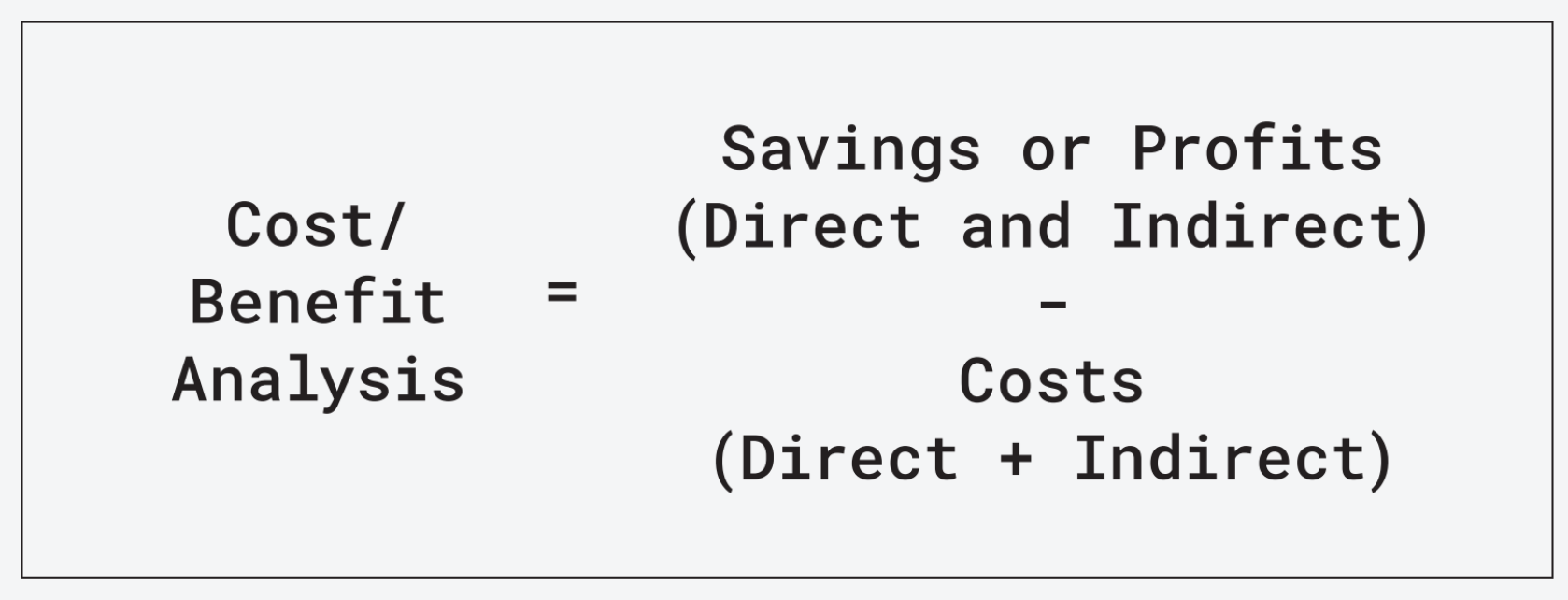
This formula does not measure relative return on investment, but instead measures overall profitability. Although this calculation can be complex, it is most accurate when all appropriate direct and indirect costs and savings are included.
2. ROI (RETURN ON INVESTMENT)
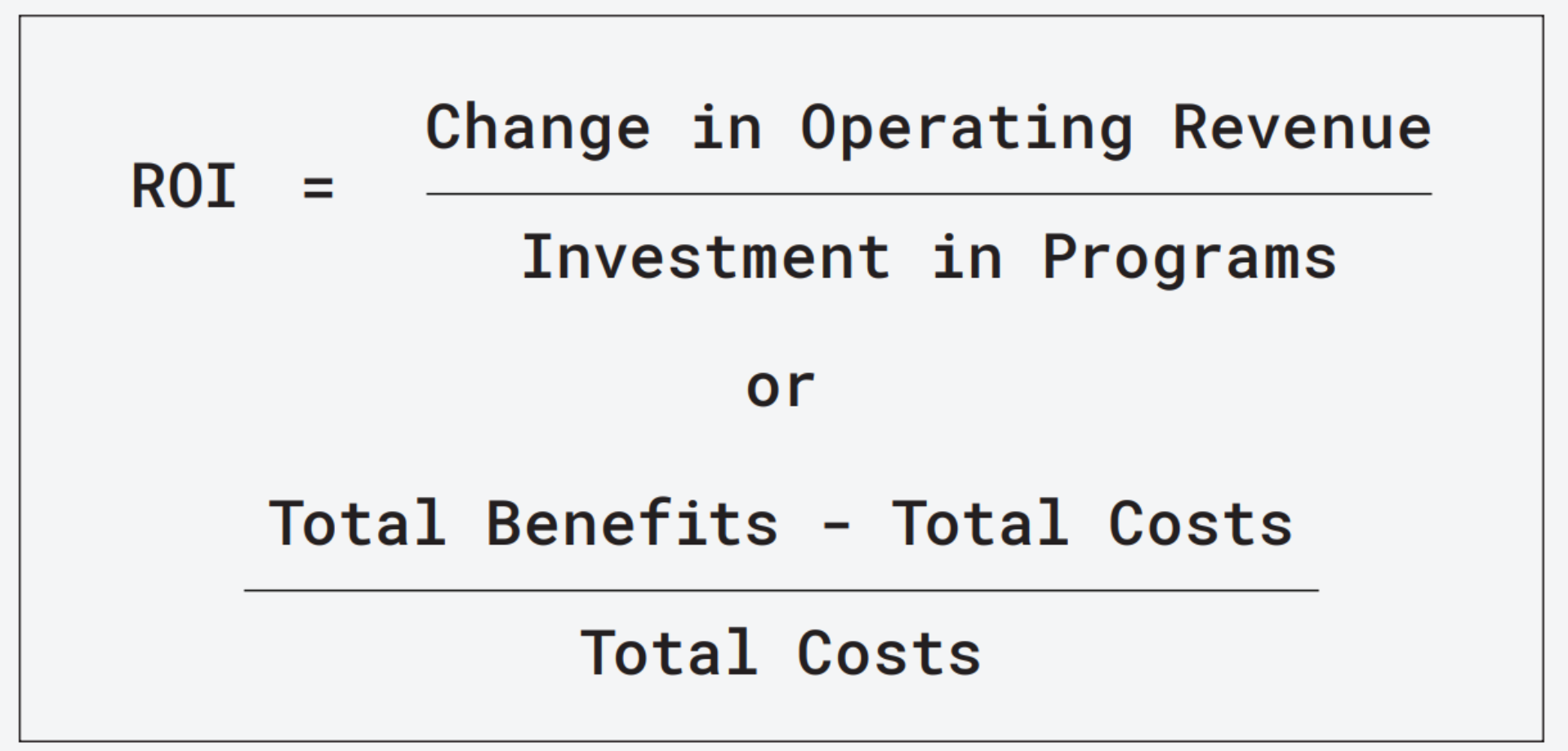
This formula compares the relative profitability of a program with the investment required to implement and maintain it.
Example: Change in Operating Revenue ($500,000) of a Back-up Child Care Center after investment of School-Age Summer Camp component ($200,000).
Formula Example: $500,000/$200,000 = Return of 2.5 (Positive ROI)
Return of $2.50 for every $1 invested.
3. BREAK EVEN POINT

This formula helps one understand the usage rate needed in order to re-coup costs.
Example: Fixed annual costs to operate an On-site Corporate Child Care Center with large Infant Care component = $800,000 per year. Cost savings (average retention savings for a new parent based on average turnover costs per exempt professional = $40,000 salary x 1.5 [Phillips and Reisman, 1992] = $60,000.)
Formula Example: $800,000/$60,000 = Must retain 13.3 new parents per year to re-coup costs.
4. Payback
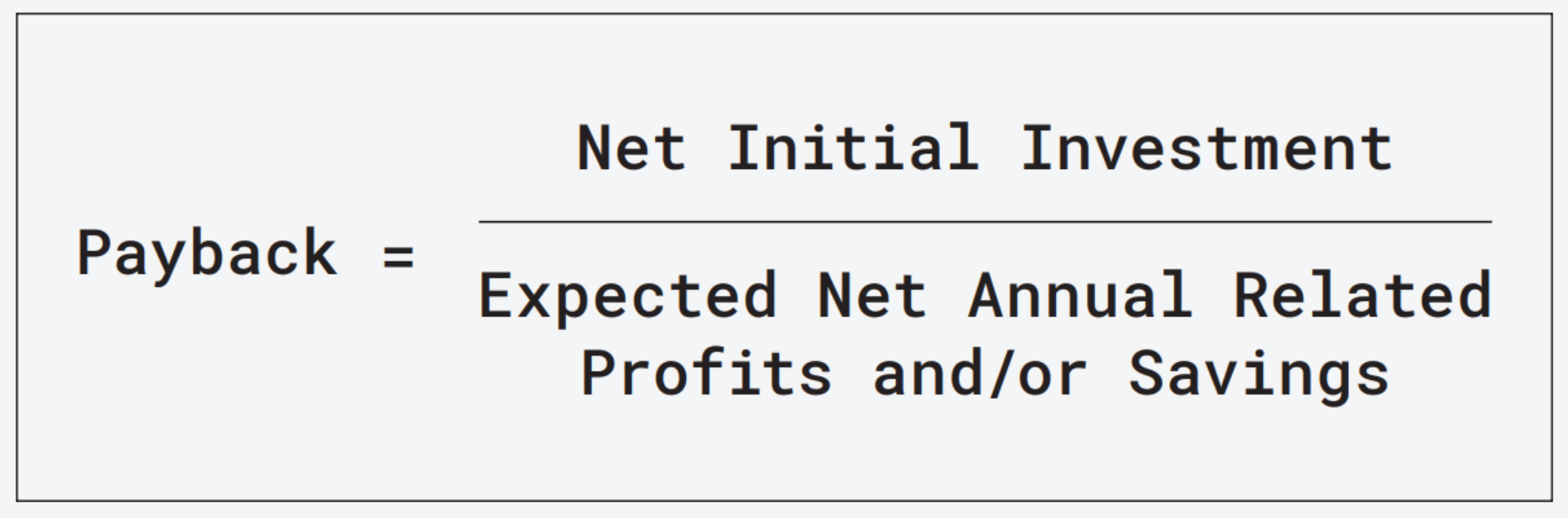
Example: Initial investment costs to build an On-Site Corporate Child Care Center = $800,000. Net Annual Savings = $570,000. (Net annual savings can come from decreased employee absenteeism and/or turnover costs, increased productivity, savings from consolidating child program administration, and possibly other outcome variables.)
Formula Example: $800,000/$570,000 = 1.4 Years
A data-driven approach comprising these steps can help define future benefit offerings.
1. GATHER CHILDCARE DEMAND DATA
Gather data on the number and type of caregivers in an organization to forecast the nature and scale of childcare support needs. For a guide on how to collect data from staff, please refer to “How to Conduct a Childcare Needs Assessment” below, a resource developed by Seramount for this toolkit. Other data sources that can help assess how childcare gaps may be affecting the employment pipeline include exit interviews, conversations with line managers, and discussions with human resources representatives who focus on recruitment.
2. COLLECT BENEFITS UTILIZATION DATA
Evaluate employee utilization of each benefit86 and causes behind low utilization rates to ensure company resources are achieving the highest ROI for employer and employee. Disaggregating data is important to discerning whether benefits are disproportionately serving a certain demographic (e.g., those with short commutes, non-traditional hour workers). If benefits are deemed both adequate and accessible by a wide sector of employees, reasons for low utilization may include lack of awareness on how to access benefits or cultural taboos around usage.
3. CALCULATE ROI OF CHILDCARE BENEFITS DATA
Quantify the impact that gaps in childcare support have on metrics such as retention, productivity, and talent attraction. Doing so can help equip businesses with data to determine which benefits would best serve both employees and the organization. Calculators, like Intuit’s employee cost calculator and methodology proposed by Cornell University, show how much an employee costs an employer beyond wages, including in taxes and benefits. See Appendix A for calculators to estimate absenteeism, turnover, cost-benefit analysis, break-even cost, and payback based on market assumptions.
4. ROLL OUT BENEFITS VIA A TEST-LEARN-ADOPT APPROACH
Employ a test-and-learn approach to experiment with various benefits, and weigh returns of new benefits before deploying them widely.
5. COMMUNICATE DEPLOYED BENEFITS TO EMPLOYEES
Communicate benefits clearly: A 2021 Voya Financial survey found that one-third of workers do not understand the benefits in which they are enrolled. Educating employees, including upper management, on benefits can increase employee contributions and help employers with cost savings on payroll taxes while increasing employee engagement and retention.
Ways to communicate benefits include:
ROUTINELY REPEATING THESE STEPS CAN HELP ENSURE BENEFITS CONTINUE TO MEET THE NEEDS OF EMPLOYEES.
Developed by Seramount, this guide offers practices employers can adopt to collect quantitative and qualitative data from staff to develop an evidence-backed understanding of childcare needs, a first step in implementing some of the strategies in the toolkit. Another sample survey has been developed by Family Forward North Carolina.
WHERE TO START
Begin with a voluntary and anonymous survey to collect hard data about employee sentiments and needs. If possible, also conduct focus groups or more expansive “Employee Voice Sessions” to dive deeper into attitudes, expectations, and behaviors related to childcare. Anonymized anecdotes elicited there can be a powerful means of communicating childcare challenges and needs with decision makers.
WHO TO SURVEY
Option 1: Survey employees caring for a child
Option 2: Survey employees caring for a child OR who plan to do so in the near future
Option 3: Survey employees caring for a child, those who plan to care for a child in the near future, and a random general population set
Use Case: Can be used to assess existing needs
Use Case: Can be used to assess both existing needs and near future needs
Use Case: Assesses existing and near-term needs but also provides an idea of how provision of services would affect general perception and behaviors toward the company
HOW TO INCENTIVIZE PARTICIPATION
Set an example: Executive team members should publicly express the need to learn more about childcare needs via this survey and can share a personal story about the importance of childcare, if applicable. Buy-in from the top is essential to motivating employee participation.
Make surveys anonymous: If possible, use a third party to host the survey or run an anonymous focus group to create an additional layer of distance between the company and the comments of the employees, which can help garner more honest feedback.
Leverage employee resource groups (ERGs): ERG events can be a good forum to in which to collect feedback from caregivers in a setting where they feel comfortable. ERG members can get the word out and enlist coworkers to participate in focus groups or complete the survey.
WHAT TO DO WITH RESULTS
Key findings should be shared with decisionmakers and staff, as relevant, with a corresponding action plan to address opportunities to close gaps revealed by the data. This leads to a sense of transparency with employees and holds the company accountable for progress on solutions.
1. Do you have, or do you hope to have, children while working here?
a. I currently have children.
b. Yes, I hope to have children while working here. (Skip to Question 8.)
c. No, I do not currently have children, nor do I plan to have any while working here. (Please only answer question 10.)
2. If you answered “yes” to Question 1, what is the age range of your child/ren? (Check all that apply.)
a. 0–2
b. 3–4
c. 5–12
d. 13–15
e. 16–18
3. Are you currently paying for childcare services?
a. Yes, I am currently paying for childcare services.
b. No, I am not currently paying for childcare services.
c. No, I am not paying for childcare services, but I would want to/plan to in the next year.
d. No, I am not paying for childcare services, and I do not want to/plan to in the next year.
4. Pre-pandemic, did you consider any of the following due to a lack of childcare services benefits offered at your company?
a. Leaving the company
b. Cutting back on work hours
c. No
5. Since the onset of the pandemic, have you considered any of the following due to insufficient childcare services benefits offered at your company?
a. Leaving the company
b. Cutting back on work hours
c. No
6. Pre-pandemic, did you ever experience reduced productivity at work due to a lack of childcare services benefits offered?
a. Yes
b. No
i. Why or why not?
7. Since the onset of the pandemic, have you experienced reduced productivity at work due to a lack of childcare services benefits offered?
a. Yes
b. No
i. Why or why not?
8. If you are paying or plan to pay for childcare services, is the cost of care so high you may consider leaving the workforce?
a. Yes
b. No
c. I am currently not paying nor planning to pay for childcare services
9. How would you rate the childcare related benefits offered by the company?
a. Inadequate
b. Adequate
c. More than adequate
10. Thinking about employees at this company as a whole, to what extent do you believe more company-provided childcare benefits would impact each of the following? (Rank each on a scale of 1 to 5 with 1 = Very Little Extent and 5 = Very Large Extent.)
a. Quality of work
b. Engagement
c. Reputation
d. Productivity
e. Retention
f. Other (Please specify)
11. What childcare benefits would most help you? (Select up to five.)
a. Direct stipend to support childcare of my choice
b. Employer-subsidized childcare center near my home
c. Employer-subsidized childcare center near my work location
d. Funding/increased funding for backup (emergency) childcare
e. Parental leave/increased parental leave
f. Option to gradually phase back into full-time work after parental leave
g. After-school care (between the hours of 3 and 6 pm)
h. Extended hour care (between the hours of 6 pm and 8 am)
i. Weekend care
j. Summer care
k. Tutoring
l. Childcare resource and referral support
m. More flexible work schedule
n. More flexible work location
o. Other
New York City Economic Development Corporation (NYCEDC) creates shared prosperity across the city by strengthening neighborhoods and creating good jobs. NYCEDC works with and for communities to provide them with the resources they need to thrive, and invests in projects that increase sustainability, support job growth, develop talent, and spark innovation to strengthen the city’s competitive advantage.
Women.nyc is an initiative of NYCEDC that helps women succeed in their businesses and careers through a variety of innovative partners and programs.
The Childcare Innovation Lab aims to make New York City the center of care economy innovation by
Seramount has more than 30 years of experience evaluating family-friendly benefits offered by employers and their impact on employees who are parents. Seramount led quantitative and qualitative research on New York City employers that provided much of the foundation for this report on behalf of the Childcare Innovation Lab. Its research helps the lab understand the behaviors driving New York City employer decisions around providing childcare support to employees, as described in the introduction.